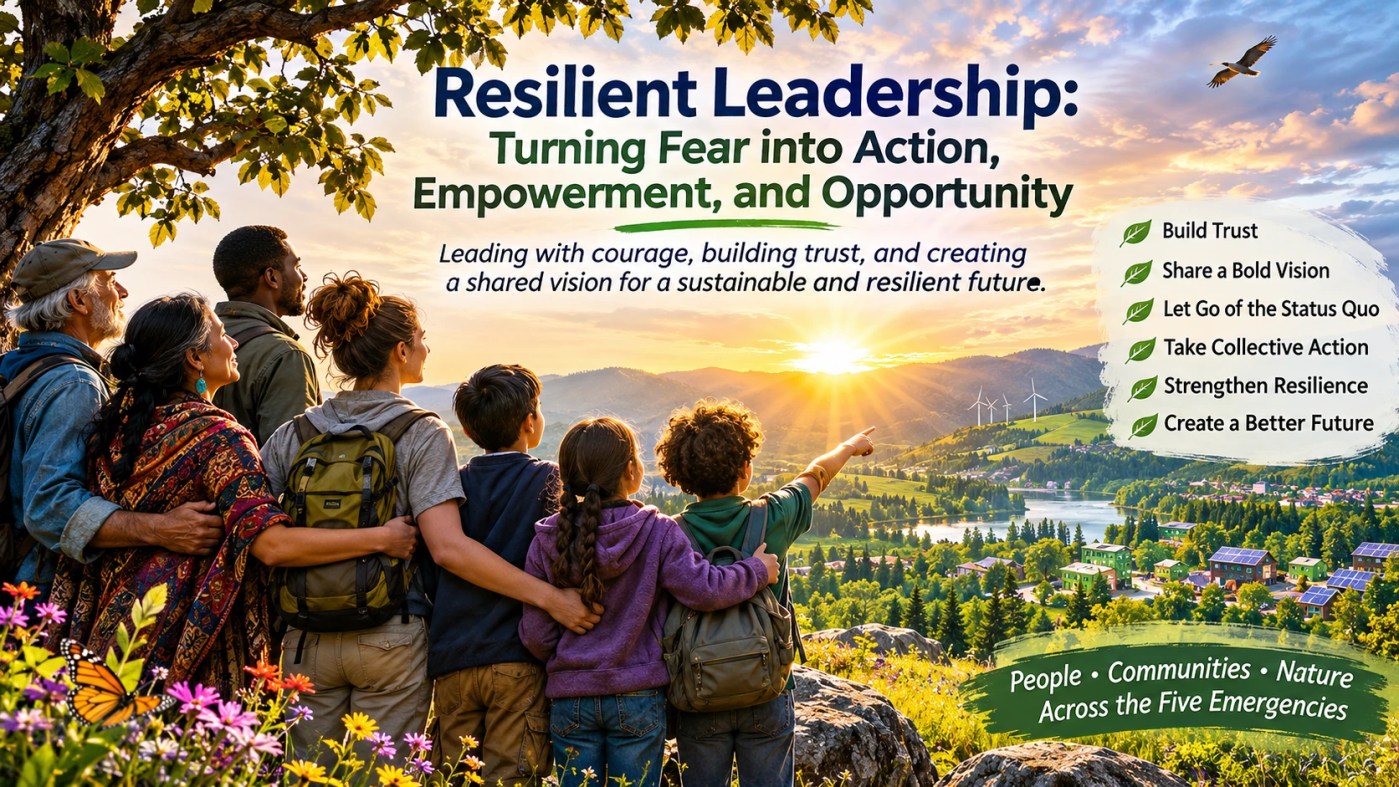
A note before we begin: I wrote the two pieces that became this post back in October 2024 and set them aside. Reading them again two years later, I find their message has only grown more urgent. I have combined them, refreshed them where the world has changed, and I’m sharing them with you now.
Fear is one of the greatest obstacles we face in confronting the Climate and Ecological Emergency. It is a powerful emotion, and an understandable one. But left unchecked, fear immobilizes us. It delays action, overshadows hope, and keeps us from building the future we urgently need.
Leadership is the antidote, and it sits at the very heart of Adaptive Resiliency. Not leadership as a title, but leadership as a practice: the ability to inspire, guide, and walk alongside others through uncertainty. The kind of leadership that will drive real change must go beyond technical knowledge. It must help people move from dread to courage, from anxiety to action, and from isolation to community.
So what does resilient leadership look like in this era of global crisis? How do we build the trust and the shared vision that collective action requires? And what mental shifts must each of us make to lead ourselves before we can help lead others?
The Qualities of a Resilient Leader
At the core of resilient leadership lies the ability to navigate complexity and uncertainty. Resilient leaders don’t just react to challenges; they anticipate them and adapt quickly. They recognize that climate change is not a single issue but a multidimensional crisis touching ecosystems, economies, democracy, and human wellbeing all at once.
A leader in this space sees the interconnectedness of these systems and understands that no challenge exists in isolation. That awareness fosters a proactive approach, opening the door to solutions that are as interconnected as the problems they seek to solve.
Building Trust Through Transparency
Trust is the foundation of any effective leadership, and in the face of the Climate Crisis it becomes even more essential. Resilient leaders build trust through transparency: by being open about the scale of the crisis, honest about the limits of their own knowledge, and clear that the solutions must be collaborative.
Honesty breeds credibility, especially in a time when misinformation, denial, and skepticism run rampant. Leaders who are upfront about the challenges ahead, and who acknowledge the discomfort of the changes required, lay a solid foundation for genuine progress.
Greta Thunberg offers one example. As a teenager, she sparked a global youth movement by speaking plainly about the severity of the crisis and telling world leaders what needed to be said, however uncomfortable it made them. Whatever one thinks of her since, that early chapter shows how transparency and authenticity can catalyze change.
Creating a Shared Vision
Leadership in the age of the Climate and Ecological Emergency demands the ability to craft a vision that transcends individual or organizational goals. A shared vision unites diverse groups around a common cause and fosters a sense of collective ownership.
That vision cannot be built on the status quo. The old ways of doing things, the same institutions, the same habits, the same top-down communication, have brought us to this point. Letting go of them is not optional; new, out-of-the-box approaches are now a necessity.
That conviction is exactly why we are building Climate Tribe Social: a community-centered platform where people learn together, dialogue across differences, and organize around the Five Emergencies (Climate, Ecological, Humanity, Democracy, and Displacement). It is not a broadcast channel. It is a gathering place designed so that members help shape its direction, and where climate concern can grow into climate competence.
Resilient leaders articulate a vision of the future that is both achievable and inspiring. That vision must be rooted in hope, not despair, focusing on what we stand to gain rather than only on what we are trying to avoid.
Inspiring hope does not mean sugarcoating the truth. Resilient leadership balances the urgency of the crisis with the promise of innovation and adaptation. The path forward will be difficult, and it can still lead to a world that is more resilient, equitable, and regenerative.
Five Mental Shifts: From Fear to Empowerment
Before we can lead others with courage, we must lead ourselves. What mental shifts are necessary to face this emergency with resolve rather than dread? Here are five that sit at the center of Adaptive Resiliency.
1. Reframing Challenges as Opportunities
Instead of viewing climate change only as an insurmountable crisis, we can also see it as an opportunity to innovate, collaborate, and build something better. By focusing on possibilities, we open ourselves to creative solutions rather than being paralyzed by the scope of the problem. Individuals and communities begin to recognize their own capacity to contribute.
2. Fostering a Growth Mindset
A growth mindset is the belief that we can learn, grow, and improve through effort and perseverance. Solutions will not always come easily, but they are within reach if we are willing to learn from failure and keep adapting. The world’s great innovators, from Thomas Edison’s thousands of experiments to today’s young organizers, understood that small steps can lead to major breakthroughs. Adaptive Resiliency thrives on this same flexibility and ongoing learning.
3. Taking Ownership of the Solutions
To move from fear to empowerment, we must recognize our own agency. Every person can make a difference, whether through lifestyle changes, community involvement, or influencing policy. This shift asks us to see ourselves not as victims of the climate crisis but as architects of a new, sustainable future. When we understand that our choices matter, we reclaim control over our impact, and as more people take ownership, collective action amplifies into systemic change.
4. Embracing Collaboration and Community
Fear isolates us. It convinces us we are facing this crisis alone. The truth is that climate action is a collective effort. From local food cooperatives to global renewable energy initiatives, people are already uniting to act. These networks offer not only practical solutions but emotional resilience, a reminder that we are stronger together.
5. Building Resilience Through Preparedness
Finally, we overcome fear by focusing on preparedness rather than panic. Adaptive Resiliency means anticipating risks and acting before they arrive: investing in green infrastructure, adopting renewable energy, building early warning systems, and learning the skills of emergency readiness. Preparedness builds resilience, and resilience breeds empowerment. When we feel equipped, we can face the future with confidence instead of anxiety.
Motivating Bold Action
People will not be moved to act if they don’t understand the stakes or if they feel powerless before overwhelming problems. Resilient leaders bridge that gap by offering a clear roadmap, breaking complex issues into manageable steps, and empowering people to take responsibility for their part of the solution.
Jacinda Ardern, as Prime Minister of New Zealand, showed what boldness can look like. In 2018 her government banned new offshore oil and gas exploration permits, and she invited businesses, civil society, and everyday citizens into the work of building a more resilient country.
But the story did not end there, and its ending carries a lesson. In 2025, a new government repealed that ban, and exploration permits are once again being issued. Bold policy announced from the top can be undone from the top. Lasting change requires something deeper: public understanding, community ownership, and grassroots support strong enough to outlast any single leader or election cycle. That is why resilient leadership must always aim to build leaders, not followers.
Leading Through Adaptation
True leadership in the climate crisis is deeply adaptive. It requires flexibility and a willingness to evolve as new information and challenges arise. Resilient leaders are not afraid to pivot; they understand that agility is key to surviving and thriving in a world where environmental, economic, and social systems are rapidly shifting.
Leaders who foster Adaptive Resiliency are constantly learning, from new climate data, from emerging technologies, and above all from the lived experiences of communities already bearing the brunt of climate impacts. They listen as much as they lead, weaving diverse perspectives into their decisions. This mindset lets them respond to challenges in real time and anticipate the risks and opportunities still ahead.
Fostering Community Resilience
Ultimately, resilient leadership isn’t about the leader. It is about empowering others to be resilient too. Strong leaders cultivate agency and self-efficacy in their communities, helping individuals and groups build their own Adaptive Resiliency. That means supporting local efforts to address climate risks, investing in nature-based solutions, and encouraging social cohesion and collaboration.
Collective, community-driven solutions outlast top-down approaches. Communities that restore wetlands or plant urban forests are not only protecting themselves from floods and extreme heat; they are strengthening social bonds and building local capacity for the long haul. Grassroots innovation is where resilience takes root.
A Call for Resilient Leadership
As we move deeper into this age of crisis, the path forward requires leaders willing to adapt, evolve, and inspire. We need people who build trust through transparency, create a shared vision that unites us, and motivate bold action that drives systemic change. The Climate and Ecological Emergency is too complex and too urgent to be tackled by individual effort alone. It demands a collective response, led by people who can navigate uncertainty, inspire hope, and foster resilience in themselves and in others.
To be a resilient leader in this moment is to be a steady light in a storm of uncertainty: charting a course through the chaos, grounded in both science and empathy, and guiding others toward a future that is not only livable but thriving. Resilient leadership, in the end, is about building a world where humanity and nature can flourish together.
In words widely attributed to anthropologist Margaret Mead: “Never doubt that a small group of thoughtful, committed citizens can change the world. Indeed, it is the only thing that ever has.”
Resilient leadership starts with each of us. We are the change-makers, the visionaries, and the stewards of our planet’s future. The future we create is a direct reflection of the actions we take today. Now is the time to lead with both courage and care.
Read posts at climatechangecommunity.com
A note on how this post was made: AI is used to enhance my creativity and thinking. The ideas, convictions, and final words are my own.
Protecting our Children & Biodiversity’s future towards a more sustainable and habitable Earth!
Compiled & Mr. Alvarez’s Thoughts | AI Enhanced.


Leave a Reply