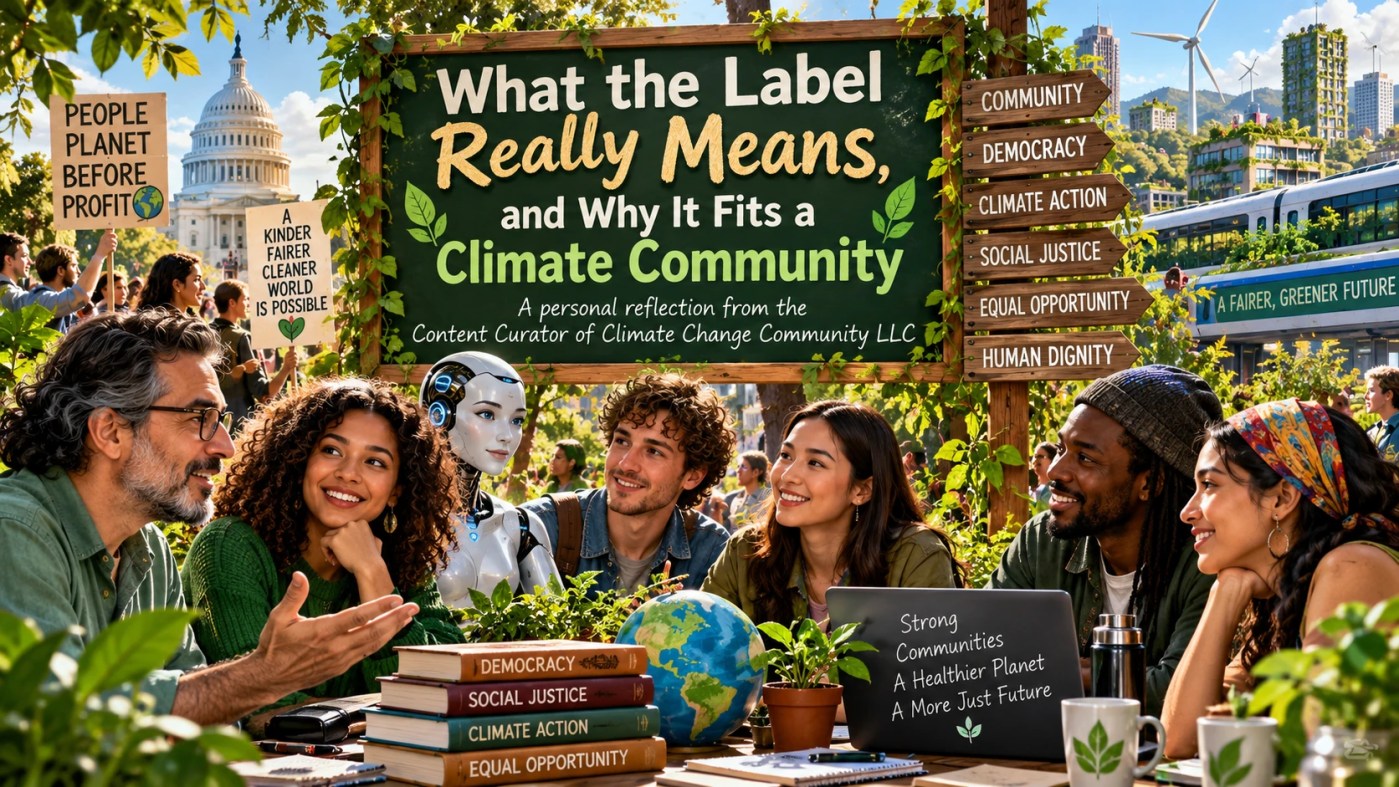
What the Label Really Means, and Why It Fits a Climate Community
A personal reflection from the Content Curator of Climate Change Community LLC
For a long time, I thought “Democratic Socialist” and “Socialist Democrat” were two ways of saying the same thing. I also kept my distance from both. The word “socialist” came wrapped in so many negative stereotypes that it never felt like something a reasonable, caring person would want attached to their name.
Then something shifted. Even before New York City elected Zohran Mamdani as mayor, I started noticing that the ideas behind democratic socialism lined up not just with my politics, but with how I think about society, about community, and about humanity itself. I sat with that for about a year. I read, I listened, and I argued with myself. Eventually I made the switch.
Today I can say it plainly: I consider myself a Democratic Socialist. I have written about this topic twice before at tito235.com, but this moment calls for a fuller explanation. The label is all over the news right now, and much of what is said about it runs on fear rather than fact.
I recently watched a YouTube video by a commentator, Mr. Beamer, that casts democratic socialism in a sharply negative light. I am not going to put words in his mouth here. Instead, I want to do what I would ask anyone to do with a label they have been taught to fear: look at what it actually means, who uses it, what they want, and where the honest criticisms lie.
What the Words Actually Mean
Start with the two words themselves.
- Democratic means power stays accountable to the people: free and competitive elections, a free press, civil liberties, and the right to oppose whoever is in charge.
- Socialism, in this context, means ordinary people should have a real say over the economic forces that shape their lives: housing, healthcare, energy, transportation, and work.
Political scientists admit there has never been one universally accepted definition. What they generally agree on is this: democratic socialism pursues greater economic equality through democratic institutions rather than authoritarian rule. That means supporting elections, constitutional government, civil liberties, and a free press, while giving the public a larger role in parts of the economy.
I also want to be honest about the fuller picture, because honesty is the whole point of this post. The Democratic Socialists of America (DSA), the largest democratic socialist organization in the country, does not describe itself as merely wanting a kinder capitalism. Its stated long-term goal is to move beyond capitalism toward collective, democratic ownership of key sectors such as energy and transportation. It pursues that goal through organizing and elections, and it explicitly rejects authoritarian models of socialism. People who use the label land in different places on how far, and how fast, that change should go. You deserve to know all of that, not a softened version.
Democratic Socialist or Socialist Democrat? Clearing Up My Own Confusion
Remember my old assumption that the two phrases were the same? The real distinction people are usually reaching for is between democratic socialism and social democracy. They share many goals, which is why they get blurred together, but they differ in how far they want to go. Here is the side-by-side that finally made it click for me:
| Social Democracy | Democratic Socialism | Authoritarian (State) Socialism | |
| Core idea | Keep a market economy, but make it fairer through a strong safety net and regulation | Extend democracy into economic life and move gradually beyond capitalism | A single ruling party directs both the state and the economy |
| Who owns what | Mostly private business, with some public services | More public, cooperative, or worker ownership of essential sectors | Centralized state ownership |
| Elections and free speech | Protected | Protected, and central to the whole idea | Restricted or eliminated |
| How change happens | Legislation, unions, coalitions | Elections, organizing, unions, ballot measures | Party decree, often backed by coercion |
| Examples often cited | Denmark, Sweden, Norway, Finland | DSA and its endorsed candidates in the U.S. | The former Soviet Union, Cuba |
One more clarification that surprised me: the Nordic countries so often held up as “socialist” are classified by most economists and political scientists as social democracies. They are capitalist economies with robust public services such as universal healthcare, subsidized education, and paid parental leave. In practice, many American politicians who call themselves democratic socialists campaign on policies that look a lot like that Nordic model.
Why the Word Still Frightens People
The fear did not come from nowhere. For decades during the Cold War, Americans learned to associate “socialism” with the Soviet Union and other one-party states that crushed dissent. Those governments did real harm, and that history deserves to be remembered, not waved away.
But look at where public opinion actually stands today. A Pew Research Center survey of 8,512 U.S. adults, conducted in January 2026 and published on June 30, found that 38% of Americans dislike political leaders who identify as democratic socialists, 17% like them, and 43% neither like nor dislike them. Among Republicans and Republican leaners, about 69% expressed dislike. Among Democrats and Democratic leaners, 32% said they like such leaders, 11% dislike them, and 56% hold no strong view either way.
What strikes me most is that the largest group is not hostile. It is undecided. That is not a reason to argue louder. It is an invitation to explain more clearly.
Why This Matters Right Now
Here in New York, Zohran Mamdani won the mayoralty in November 2025 and was sworn in on January 1, 2026, after campaigning on a rent freeze, free buses, and universal childcare. At his inauguration he told the city, “I was elected as a democratic socialist and I will govern as a democratic socialist.” He also faced heavy pushback from parts of the business community and from Republicans who cast him as a radical. Whatever your view, his tenure will be judged on whether those promises translate into real affordability for real families.
Nationally, the midterm elections are now just one week away. As of yesterday, Ballotpedia reported that DSA and its local chapters have endorsed 131 candidates on the November 3 ballot across 30 states and the District of Columbia, and have taken positions on 33 state and local ballot measures. DSA says it now has more than 100,000 members, with chapters in all 50 states. Some commentators, including an opinion writer at The Washington Times, find that growth alarming. Others find it hopeful. Either way, the label is no longer on the fringe of American life, which makes understanding it more important than ever.
What Democratic Socialists Actually Advocate
Strip away the slogans and here is what prominent democratic socialist candidates and DSA commonly support:
- Medicare for All, or a single-payer healthcare system
- Stronger labor unions and worker protections
- Higher taxes on the wealthiest Americans
- Affordable housing initiatives
- Tuition-free public college and universal childcare
- Expanded climate investment through proposals like the Green New Deal
- Public options or public ownership in certain essential services
You may agree or disagree with any item on that list. But none of it is monstrous. Every one of these is a policy that can be debated, costed out, tested, and improved. That is how democracy is supposed to work.
Why It Fits the Values of Climate Change Community
My climate awareness was born in February 2007, alongside the release of the IPCC’s Fourth Assessment Report. Over the years since, I have come to see the Climate and Ecological Emergency as more than a scientific problem. It is a question of who decides and who pays. Energy, transportation, and housing are where most emissions come from, and they are exactly the sectors democratic socialists want to make accountable to the public. Meanwhile, heat waves, floods, and displacement hit working families and the poorest communities first and hardest.
When I look at the values we have built into Climate Change Community LLC, I see the same thread:
- A hard salary cap, so no one gets rich off a crisis that is hurting others.
- A Financial Support Program that redistributes excess revenue back to members and communities.
- Shared stewardship. I call myself Content Curator, not owner or founder. I intend to pass ownership to the next generation, and I want our members to play a big part in calling the shots on growth and decisions.
I did not copy those values from any party platform. I arrived at them by asking what a climate organization owes the people it serves. Only later did I realize how closely they echo democratic socialist ideas: limits on accumulation, shared stewardship, and decisions made together.
And let me be just as clear about this: democratic socialism is my personal political home. It is not a membership requirement. Our mission, protecting our children’s future and biodiversity, welcomes conservatives, liberals, libertarians, independents, and people who want nothing to do with labels at all. Floodwater does not check anyone’s voter registration. A neighborhood cooling center needs volunteers from every political background.
What the Critics Get Right
A post defending democratic socialism would not be honest if it pretended the critics have nothing to say. They do, and their concerns deserve real answers:
- Cost. Many of these proposals would require substantially higher taxes and federal spending, and economists still debate their long-term effects.
- Government power. Critics worry that expanding public control of the economy concentrates too much power in the hands of officials, and could slow growth or discourage private investment.
- History. Regimes have used the word “socialist” to justify repression. Any movement using the word should be able to explain, clearly and specifically, how it protects dissent, pluralism, and independent institutions.
I would rather be challenged on these points than flattered. Democratic socialists in office, and those of us who advocate in our own small corners, should be judged on results and on how we treat people who disagree with us, not on slogans. That standard applies to me, too.
When Someone Calls Democratic Socialists Monsters
If you identify with this label, sooner or later someone will tell you it makes you dangerous. You do not have to answer with anger. Try a few questions instead:
- Which specific policy or belief are you objecting to?
- Do you mean a political philosophy, a particular organization, or a historical government?
- What evidence supports that view?
- Would you judge me by my actions and my ideas, or only by the word I use?
Questions like these turn a shouting match into a conversation. You might even discover you agree on more than you expected, especially when the conversation turns to clean air, safe water, and a livable future for the kids in your life.
Labels Are Not Verdicts
Democratic Socialists are not monsters. Neither are conservatives, liberals, or libertarians. No political identity tells you enough to judge an entire human being. What people do, how they treat others, and whether their ideas hold up under scrutiny: that is what matters.
I came to democratic socialism slowly, cautiously, and after a lot of reflection. I stayed because its core aspirations match what I have spent nearly two decades working toward: dignity for every person, accountability for concentrated power, and a habitable planet for the generations coming after us. Challenge the policies. Demand evidence. Hold leaders accountable, including the ones I agree with. But let’s stop turning neighbors into caricatures. The Climate and Ecological Emergency is too big, and too urgent, for us to face it divided.
AI is used to enhance my creativity and thinking in preparing this post. The journey, the views, and the responsibility for them are my own.
Protecting our Children & Biodiversity’s future towards a more sustainable and habitable Earth!
Compiled & Mr. Alvarez’s Thoughts | AI Enhanced.
Sources and Further Reading
- Democratic Socialists of America: What Is Democratic Socialism?
- Pew Research Center (June 30, 2026): About a third of U.S. Democrats like political leaders who identify as democratic socialists
- The National Desk Fact Check Team (July 15, 2026): Democratic Socialism explained
- Ballotpedia News (Oct. 26, 2026): DSA backs 131 candidates in 30 states ahead of Nov. 3 elections
- Ballotpedia News (Oct. 13, 2026): DSA takes positions on state and local ballot measures
- Reuters via Yahoo News: New York Mayor Mamdani vows to enact democratic socialist agenda
- The Washington Times (Oct. 7, 2026, opinion): a critical view of DSA’s down-ballot growth
- The video that prompted this post: Mr. Beamer on YouTube


Leave a Reply