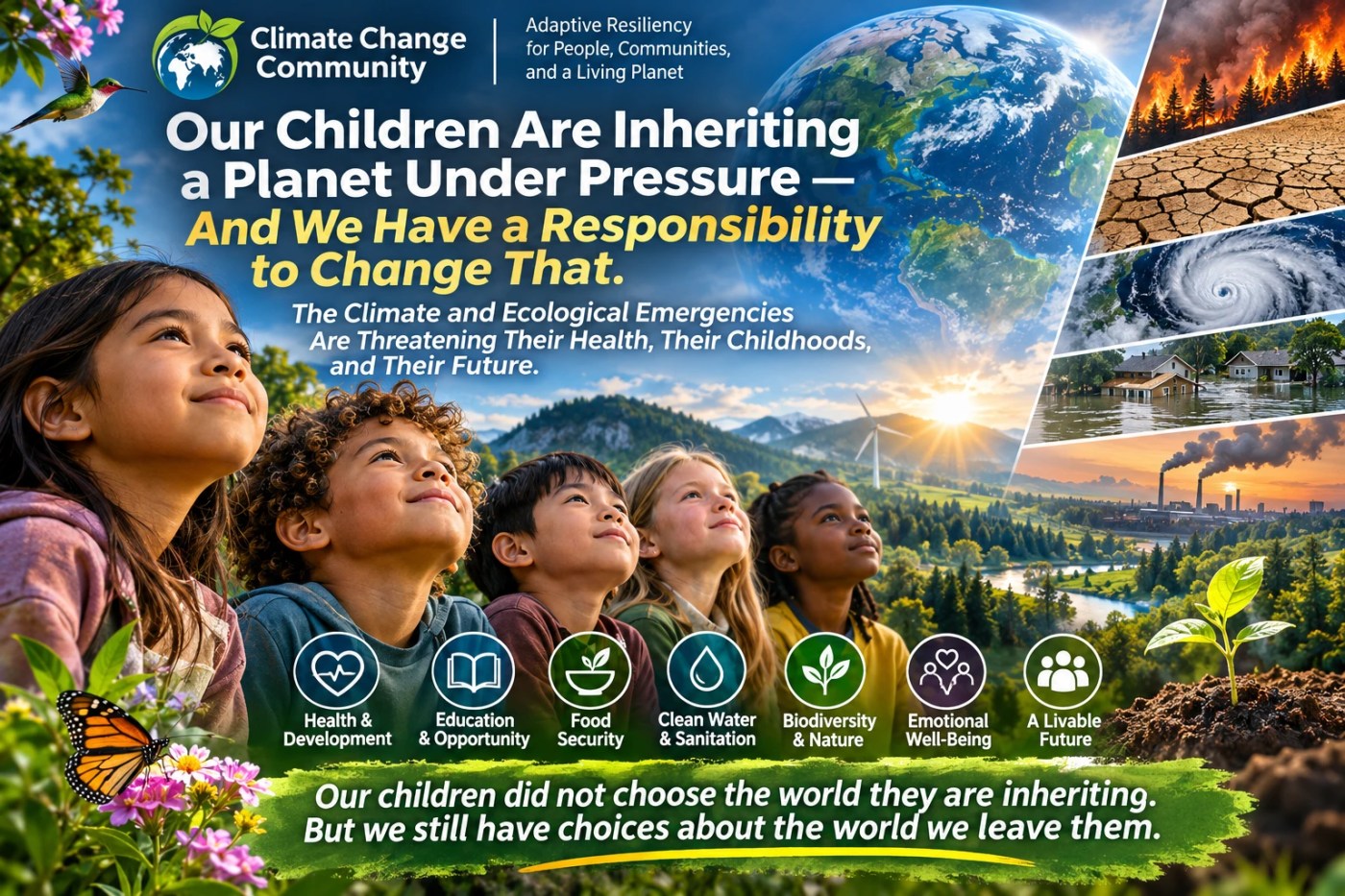
Because protecting our children means protecting the living world they depend upon.
I want to begin by saying something plainly. This is not a report, and I am not writing it as an expert standing at a podium. I am writing it from my heart, as a man who has spent close to two decades watching the Climate and Ecological Emergency grow from a warning into a daily reality, and who cannot stop thinking about the children who will live with what we decide. Of everything I have written, this may be the piece that matters most to me, and I ask you to read it in that spirit.
There is a question I keep coming back to, and I believe all of us should be asking it of ourselves: what kind of world are we leaving to our children, and what are we doing today to change its direction? Not someday. Not when another election comes around. Not when another international conference ends with promises that may or may not be kept. Today.
Children did not create this crisis. They did not authorize the clearing of forests, the poisoning of waterways, the stripping of soils, the destruction of wildlife habitat, or the staggering consumption that has pushed our natural systems to the edge. Yet they are the ones inheriting the consequences. Around the world, children are growing up in an increasingly unstable environment, where extreme heat, wildfire, drought, flooding, polluted air, vanishing biodiversity, water insecurity and failing ecosystems are changing the very conditions in which they are born, grow, learn, play, and will one day raise families of their own.
So when I talk about the climate, I am not talking about an abstract policy debate. I am talking about childhood itself. I am talking about human dignity, public health, food on the table, a place to learn, and the most basic right of all: to inherit a planet where life can flourish. That responsibility does not belong to someone else. It belongs to all of us, and it belongs to me.
The Numbers That Keep Me Up at Night
In June 2026, UNICEF released its Children’s Climate Risk Report 2026, and I have not been able to put it down. It found that 1.1 billion children, nearly half of all the children on Earth, are exposed to at least three overlapping climate hazards. About 1.5 billion children live with more frequent, longer or more severe heat waves, and 1.2 billion are exposed to extreme heat. Some 1.8 billion children face drought, 662 million live where tropical storms strike, and more than 200 million are exposed to more frequent or severe fires.
I share these figures not to overwhelm anyone, but because each of those numbers is a child with a name, a family and a future. And these hazards do not arrive one at a time. They pile on top of each other. A child in a drought-stricken region may also go hungry, drink unsafe water, live without proper sanitation and have no doctor within reach. A child in a region of extreme heat may find no relief at home, at school or outside. A child whose family loses its home to a flood may also lose school, health care, familiar streets and the community that held them together. When the storm passes or the water recedes, the damage to that child’s life very often does not.
Source: UNICEF, The Children’s Climate Risk Report 2026
Heat Is Taking Away a Safe Childhood
Children are especially vulnerable to extreme heat. Their bodies are still developing, and infants and young children have a harder time regulating their temperature than healthy adults. Dehydration, heat exhaustion and heatstroke become real dangers, most of all for families without reliable electricity, cooling, clean water or medical care nearby.
But there is something else about heat that breaks my heart, and I do not think we talk about it enough. Heat is changing the places where children can simply be children. Playgrounds become dangerous. Games and sports are cancelled. Classrooms without ventilation or cooling become places to endure rather than places to learn. In the hottest regions, children are losing the chance to run outside, explore nature and grow up as part of their neighborhoods, and for children already living in poverty or crowded housing, it is worse still. Heat reaches families in quieter ways too. When it hits farmworkers and outdoor laborers, household income and food security fall with it. The cost of heat goes far beyond what the thermometer shows.
Our Children Are Breathing the Consequences
Few things are more immediate than the air a child breathes. Air pollution comes from burning fossil fuels, from traffic, industry, agriculture and construction, and increasingly from wildfire smoke that can drift hundreds of miles and settle over children who never saw the flames. Fine particles, known as PM2.5, can travel deep into the lungs. Children are especially exposed because their lungs and organs are still forming, and because they breathe more air for their body weight than adults do. The results include more respiratory illness, more asthma attacks, and lungs that do not develop as fully as they should.
This is not only a problem in faraway places. Communities across the United States, Europe, Asia, Africa and Latin America live with harmful air. I refuse to accept a world in which a child’s access to clean air depends on their family’s income, their neighborhood or the country they happen to be born in. Clean air should be a basic condition of childhood, not a privilege.
We Are Losing the Living Systems That Protect Them
The Climate Emergency rightly receives a great deal of attention. But another crisis is unfolding right beside it, and I believe it is just as serious: the Ecological Emergency. Biodiversity loss, habitat destruction, deforestation, degraded soil, contaminated fresh water, overfishing and pollution are wearing away the living systems that sustain human life. Forests regulate water and store carbon. Wetlands soak up floodwaters and filter what flows through them. Healthy soils feed us and hold water. Oceans support the food webs and livelihoods of millions. When these systems weaken, our children inherit a world with fewer natural protections and far more instability.
A scientific review in the journal Pediatric Research, published online in December 2024, looked closely at the links between urban biodiversity, climate change and children’s health. The researchers described how the loss of biodiversity weakens nature’s ability to shield us from climate impacts, and how that raises the risks to children’s health. That connection matters to me deeply. We tend to talk about biodiversity in terms of endangered species and conservation statistics, but it is also about whether the ecosystems our children depend on can keep working.
And beyond the science, there is something I feel in my bones. Children need more than a planet that can technically keep humans alive. They need a living world. They deserve to know forests, rivers and oceans, to hear birdsong, to watch pollinators at work, to put their hands in healthy soil, and to stand in awe of the extraordinary diversity of life that makes this planet worth protecting.
Food, Nutrition and the First Years of Life
Agriculture depends on predictable seasons, healthy soils, enough fresh water, working pollination and a stable natural world. Climate change is disrupting all of it through drought, heat, shifting rainfall, floods and harder growing seasons, while biodiversity loss and land degradation quietly weaken the foundations underneath. The result can be smaller harvests, lost crops, lower family incomes and higher food prices. For families already stretched thin, that can be devastating.
Children feel it first. The first 1,000 days of life, from conception to a child’s second birthday, shape physical growth, brain development and lifelong health. In September 2026, UNICEF published Environmental Determinants of Undernutrition and Micronutrient Deficiencies in Children, which examines how environmental hazards such as heat, pollutants, biological hazards and poor water, sanitation and hygiene affect children’s nutrition. It is a powerful reminder that we cannot feed children well by growing more food alone. We must also protect the environmental systems that make healthy food, clean water and healthy development possible.
When Disaster Uproots a Child
When disasters strike, children carry consequences that reach far beyond the physical damage. A flood can destroy a home, contaminate drinking water, interrupt school and separate families. Wildfires can erase whole communities and fill the air with smoke. Drought can undo farms and livelihoods and, in time, push families to leave. A damaged school may stay closed long after the water recedes, and a clinic may lose power or clean water just when it is needed most. For a child, being displaced can mean losing the familiar surroundings, friendships, routines and sense of safety that help them grow.
This is where the climate crisis becomes, unmistakably, a question of justice. Children living in poverty, in conflict zones, in informal settlements, on small island nations and in places with little infrastructure face the greatest risks with the fewest resources to recover. Their vulnerability says nothing about their worth or their potential. It says everything about the inequalities that we, as adults and as institutions, have a responsibility to correct.
The Weight They Carry Inside
I also worry about what this is doing to young hearts and minds. Children and young people are growing up with constant access to images of burning forests, dying wildlife, melting glaciers, plastic-choked shorelines and families losing everything. Some live through these events directly; others absorb them through the news, social media and the worried conversations of the adults around them. Disasters can leave trauma, anxiety, grief and long-lasting stress, especially for children who lose their homes or watch their families’ livelihoods disappear.
At the same time, I do not believe every child’s concern for the planet should be labeled a mental health problem. Very often it is compassion. It is awareness. It is a young person’s wish to protect the world they love. What they need from us is honesty without dismissal, information they can trust, emotional support, and real opportunities to be part of the solutions. Let me say this as clearly as I can: we must not hand our children the burden of saving the planet. We should invite them to help build a better future, while we adults accept responsibility for the decisions that brought us here.
Education as a Pillar of Resilience
Education is one of the strongest tools we have, but it has to go deeper than memorizing terms for a test. I want every child and young adult to understand how the climate system works and why emissions matter, how ecosystems function and why biodiversity is essential, why soils, forests, wetlands and oceans matter, how pollution harms people and nature, and how food systems, water systems and whole communities can become more resilient. I want them to learn how renewable energy, conservation, restoration and thoughtful design can help, and how a community prepares for an emergency and responds when one arrives. And I want them to be able to tell trustworthy science from misinformation, because they are growing up in a world full of both.
Above all, we must listen to them. Young people are not merely future stakeholders. They are members of our communities right now, and environmental decisions are already shaping their lives. Their voices belong in conversations about schools, transportation, energy, housing, land use, conservation and planning. UNICEF’s 2026 report calls for exactly this kind of meaningful participation by children and young people in climate action and decision-making, and I could not agree more.
Adaptive Resiliency: From Awareness to Collective Preservation
Recognizing the dangers is necessary, but awareness alone will not protect a single child. We have to move from understanding these emergencies to building real responses, and this is where Adaptive Resiliency comes in. I define it from the standpoint of both self and collective preservation: developing the knowledge, relationships, resources and systems that help people and communities withstand shocks, adapt to change and rebuild in healthier, more sustainable ways, while also addressing the conditions that made them vulnerable in the first place.
In practice, that can look like neighbors growing food together in community gardens and vertical gardens, sharing seeds, supporting local farmers’ markets, and trading produce, skills and knowledge through local barter and cooperation. It means protecting watersheds, wetlands, rivers and groundwater, conserving water and making sure every family has safe water to drink. It means protecting the forests and habitats we still have, restoring what has been damaged, reconnecting broken habitats and caring for native species and pollinators. It means shade trees, green spaces, cooling, flood protection, safe buildings and real emergency plans for our schools and neighborhoods. It means a faster move away from fossil fuels, more efficient homes and clean transportation that everyone can use. And it means building relationships between neighbors, local organizations, educators, scientists, businesses and public institutions. Resilience is not only about surviving the next disaster. It is about reducing the conditions that make disasters so destructive, and creating communities where people and nature can thrive together.
Five Emergencies, One Future
At Climate Change Community, we speak of five connected emergencies. The Climate Emergency is the rapidly changing climate and its consequences for people and nature. The Ecological Emergency is the loss of biodiversity and habitat, the spread of pollution, and the decline of the living systems that sustain us. The Humanity Emergency is the human toll of cruelty, inequality, exploitation, division and the erosion of compassion and dignity. The Democracy Emergency is about accountable institutions, truthful information, public participation and our shared power to shape the future. The Displacement Emergency is the growing struggle of people forced from their homes by disaster, conflict and instability.
These emergencies cannot be solved one at a time. Environmental destruction weakens food security, food insecurity feeds social instability, climate disasters drive displacement, and displacement strains public services and deepens inequality. The connections are real, and so our responses have to be connected too. Protecting children means addressing the whole picture.
What We Can Do Together
No single organization, government, scientist or person can meet these challenges alone. We need cooperation across generations, professions, communities, cultures and borders. We need scientists sharing their research, educators widening environmental literacy, farmers restoring soils, communities protecting their local ecosystems, businesses taking responsibility for their impact, and governments putting the public good ahead of short-term political and economic convenience.
And meaningful change does not always start big. It can begin with a neighborhood growing food together, a community restoring a local wetland, a school planting a native pollinator garden, neighbors checking on one another before a heat wave, a family learning to waste less and conserve water, a local group helping residents understand their climate risks, or a young person discovering a calling in conservation, science, environmental justice or organizing. None of this replaces the large-scale policy changes and emissions cuts we urgently need. It works alongside them. And it creates something just as precious: communities that know each other, trust each other and are ready to face uncertainty together.
My Promise to the Children
I am not a climate scientist, and I have never claimed to be. I am someone who believes that learning is a responsibility, that truth matters, and that the protection of children and biodiversity should sit at the center of how we measure progress. I listen to scientists, researchers, educators, environmental defenders and the people living through these emergencies firsthand. I also believe technology, including artificial intelligence, can help us organize information and learn faster when it is used responsibly. But technology cannot replace a human conscience. It cannot replace compassion, accountability or the courage to make hard decisions. Those remain ours.
So here is my commitment, made from the heart. I will keep learning, keep asking questions, keep sharing credible information and keep working toward practical solutions. I want my nieces and nephews, my friends’ children and every child in every corner of this world to grow up where clean air, safe water, healthy food, thriving biodiversity and a stable climate are not luxuries. I want them to experience the wonder of nature, not inherit only its remnants. I want them free to create, explore, learn, love and build their lives without carrying the weight of damage that earlier generations left unresolved. And I want them to know that there were people who cared enough to stand up, speak out, learn, cooperate and act.
That is why Climate Change Community exists. Not to promise that we can fix everything, and not to pretend the road ahead will be easy, but to create a place where knowledge becomes connection, connection becomes cooperation, and cooperation becomes meaningful action. We cannot change yesterday. But we can change what we do today. We can protect what remains, restore what has been damaged, prepare our communities, challenge destructive systems, and insist that the well-being of future generations matters.
Our children did not choose the world they are inheriting. But we still have choices about the world we leave them. Let us make those choices count. Let us protect the children, protect biodiversity, and protect the living systems that make life possible. And let us never forget that the future is not something we simply inherit. It is something we build together.
Addendum: An Invitation to Be Part of a Green New Way Forward
We are not just talking about climate action. We are building something to help make it happen.
An Addendum to Our Mission: A Sacred Vow to the Future
If you could see what we are building inside Climate Tribe Social, working alongside an advanced AI collaborator, I genuinely believe you would be blown away. And I believe you would feel something else at the same time, something I feel every single day: an urgency to be part of it.
Because what we are building is not another social network. It is not another discussion forum, and it is not another place to scroll through alarming headlines about the state of our planet and then close the screen feeling worse than before. We have all had enough of that.
We are working to build a Green New Way Forward.
Think about it for a moment. Everywhere we look, people are talking about climate action. Millions, perhaps billions, of people are worried about the future of humanity. You can feel it in everyday conversations, in news reports, in scientific journals, around kitchen tables and across social media. People know something is terribly wrong. Many are frightened. Others are frustrated, angry, overwhelmed, or simply exhausted by an endless stream of bad news about the only home we have.
And yet there is a vast gap between knowing that action is needed and having the structure, the relationships, the knowledge, the cooperation and the opportunities to actually move things forward. Concern without a place to go becomes despair. Good intentions without connection fade away. I have watched that happen for years, and I am tired of watching it.
That gap is precisely what we intend to close.
Thinking Beyond the Traditional Approach
Climate Change Community, together with its community platforms, is developing an out-of-the-box approach to systemic climate and ecological action. Our flagship community, Climate Tribe Social, is being built as a large-scale online gathering place dedicated to the Five Emergencies:
- The Climate Emergency: the rapidly changing climate and what it means for people and the natural world.
- The Ecological Emergency: the collapse of biodiversity, habitats and the living systems that sustain us.
- The Humanity Emergency: the cruelty, inequality and division that erode our dignity and our ability to care for one another.
- The Democracy Emergency: the health of our institutions, the truth of our information and our shared power to shape the future.
- The Displacement Emergency: the growing number of people forced from their homes by disaster, conflict and instability.
These emergencies are woven together. They feed one another and compound one another, and they cannot be solved by people working in isolated corners. That is why we refuse to treat them separately.
Our vision is ambitious, and I make no apology for that. We aim to build one of the largest online communities dedicated specifically to understanding, connecting and responding to these five emergencies. But I want to be equally clear that we are not interested in collecting members and counting registrations. A number on a dashboard has never protected a single child or saved a single species.
We want participation. We want ideas. We want expertise. We want constructive disagreement, collaboration, innovation and practical solutions. We want people who are ready to roll up their sleeves. Our companion learning community, SDL5.org, will carry this approach further through a different environment built for self-directed learning and collaboration. Together, these efforts are part of a far larger undertaking than any one website.
We Need You. Yes, You!
We are looking for people from every walk of life. Climate scientists, meteorologists, ecologists, biologists and environmental researchers. Engineers, educators, health care workers and front-line responders. Climate justice advocates, activists and community organizers. Farmers and gardeners, writers and artists, technologists and entrepreneurs. Mothers, fathers and grandparents. Young adults just finding their footing and retired professionals carrying decades of hard-won wisdom.
You do not need a string of academic credentials to have something valuable to offer. You might have spent your life studying atmospheric science. You might be a farmer who has watched the growing season change with your own eyes. You might be a mother lying awake at night thinking about the world her children will inherit. You might be an organizer who knows how to bring a neighborhood together. Or you might simply be someone with an idea that nobody has taken seriously yet.
We want to hear from you.
There is room here for scientific expertise, professional experience, practical know-how, creativity and fresh thinking. What matters most is your willingness to participate constructively and your respect for the people around you.
A Community Where Humanity Comes Before Hostility
Let me be very clear about something, because it matters to me as much as anything else in this post.
We are not building another online space where people come to attack one another, spread hatred, demean others, or turn every conversation into a battlefield. Division, racism, cruelty, deliberate disrespect and harassment have no place in the community we are building. None.
We can disagree. We can challenge assumptions. We can question research, policies, strategies and long-held ways of thinking. In fact, I encourage it! Honest disagreement is how good ideas get sharper. But we will never confuse constructive disagreement with personal attacks or the deliberate mistreatment of another human being. I intend to be among the first to stand up to any behavior that threatens the dignity and safety of this community.
We have enormous problems to solve. We do not need to manufacture more hostility among the very people who could be working side by side.
Our common ground is the future of life on this planet.
There Is a Very Big Monster in the Room
Let’s stop pretending that everything is going to work itself out. It is not.
Climate disruption. Ecosystem collapse. Species extinction. Pollution. Deforestation. Water insecurity. Food insecurity. Inequality. Displacement. Political dysfunction. The list is long, and the consequences are becoming impossible to ignore. They are no longer predictions in a report. They are in our weather, our grocery bills, our insurance letters, our hospitals and our children’s classrooms.
We can bury our heads in the sand. We can keep serving systems driven by short-term greed and exploitation. We can surrender to willful ignorance, or tell ourselves it is already too late to matter. But what does any of that accomplish? Nothing. Absolutely nothing. And I refuse, with everything in me, to accept that helplessness is the only option we have left.
Yes, the challenges are enormous. Yes, some losses are already irreversible. Yes, the cost of delay is already being paid by millions of people and countless other living beings. But that makes meaningful action more important, not less. Every fraction of a degree, every protected forest, every restored wetland, every community that prepares instead of panics, every child who grows up informed instead of afraid: all of it still matters.
We must stop treating climate action as something that belongs only to governments, international institutions, corporations and a small circle of established organizations. They carry enormous responsibilities, and we must hold them to those responsibilities. But the future is not built by those in power alone.
It is shaped by all of us.
Our ideas matter. Our voices matter. Our communities matter. Our ability to organize, cooperate, innovate and hold institutions accountable matters. Every one of us can become a visionary. Every one of us can contribute to solutions. And we can start right now.
Welcome to The Idea Engine!
One of the Spaces inside Climate Tribe Social, part of The Humanity Emergency Collection, is called The Idea Engine, and the name is intentional. I believe some of the most important solutions of our time may come from conversations between people who would never otherwise have met.
Imagine a climate scientist, a community organizer, an agricultural specialist, an engineer, an educator and someone with a wildly unconventional idea sitting at the same table. Now imagine giving them a place where they can trade knowledge, challenge each other’s thinking, shape rough concepts into real proposals, and explore how to turn those proposals into practical initiatives. That is the kind of meeting of minds we want to make ordinary.
We have been working tirelessly on the community’s content, Spaces, learning resources and structure, and the body of work is already substantial and still growing. And I have plenty more ideas waiting in my own mental filing cabinet! Some are ambitious. Some are unconventional. Some will need serious research and development. Others may turn out to be surprisingly simple.
Not every idea will work, and that is fine. What we need is a place where promising ideas can be examined, improved, challenged and given a real chance. That is how innovation happens. It never happens in silence.
A Community Where Members Have a Voice
We also hold a particular belief about how this community should grow. We do not want another platform where a small group makes every decision while everyone else is expected to follow along. That model has failed us in too many places already.
Our direction is toward real member participation and collaborative development, a community where people help decide what gets built and how it evolves. In practice, that voice will come through member polls, through proposals brought to The Idea Engine, and through our 11-Person Dialogue Sessions, small face-to-face conversations where members can be heard rather than simply counted. Influence here is earned by showing up and taking part, not by how early someone joined or how much they paid.
Participation means more than having a profile and posting comments. It means contributing ideas, knowledge, experience and constructive criticism, and helping shape the environment we are creating together. We are still building that model, and we intend to build it carefully and responsibly, because a community’s trust is far easier to lose than to earn.
Our Financial Support Program
There is one more part of this work that is very close to my heart, and I want to explain it simply.
Climate Tribe Social is built around a Financial Support Program, which we call the FSP. The idea behind it is straightforward. Your subscription keeps the platform running. When revenue grows beyond what it takes to run and sustain the community, we intend to send that excess back out to where it can do good: to members and communities facing real hardship, and to people doing meaningful work who are held back by financial limits. In other words, the money this community raises is meant to circulate back into the community, not pile up somewhere else.
I also want to be honest about what the FSP is today. It is a commitment we are building, not a fund that is already paying out. Being a subscriber does not guarantee a grant, a payment or a distribution. Any support will depend on how much revenue the community actually generates, on fair eligibility rules, and on how the program operates once it is fully in place. We are taking the time to get those details right, with proper legal review, because a promise made to people in need has to be kept.
For the full explanation, who will be eligible, and updates as the program develops, please read our Financial Support Program posts on the Climate Change Community blog: climatechangecommunity.com/tag/financial-support-program.
What I can promise you now is the principle behind it. Financial circumstances should never be the reason a talented, committed and constructive person is shut out of meaningful work. Not here.
Building for Something Much Bigger Than a Membership Number
Our public opening is planned for Sunday, December 21, 2026, and we have been welcoming invited founding members since August 24. We have an ambitious vision, but we know that a meaningful community takes time, participation, trust and hard work to build. There are no shortcuts, and we are not looking for any.
I am not asking you to believe that we have all the answers. We do not. I am asking you to consider becoming part of a place where we can find more of them together.
If you are a scientist, a professional, an educator, an environmental advocate, a parent, a grandparent, a community builder, a creative thinker, or simply someone who refuses to surrender to apathy, we would love to hear from you. Bring your knowledge. Bring your experience. Bring your questions. Bring your ideas. And bring your willingness to work beside people who may see the world very differently from you. We do not need everyone to think alike. We need people who can work together in spite of their differences, because that is exactly what this moment demands.
Your Invitation Is Waiting
I have poured an enormous amount of thought, time, research and personal commitment into this undertaking. I know there is still much to do. I know there will be obstacles, disagreements and setbacks along the way. But I also know, without any doubt, that doing nothing is not an acceptable alternative.
We have children growing up in a world they did not create. We have species disappearing before we have even understood their place in the web of life. We have communities facing harder and harder conditions every year. And we have extraordinary human potential, brilliant, caring, capable people all over this world, sitting disconnected and underused, waiting for a chance to come together.
What if we could connect more of that potential?
What if we could build a place where knowledge meets imagination, where science meets lived experience, where ideas meet opportunity, and where people from every background work toward a shared purpose? That is the Green New Way Forward we want to help build, and I am inviting you, personally, to be part of it.
If you would like an invitation and instructions for joining as a founding member, write to me directly. For everyone’s security, please send your email without links, and we will reply with everything you need to get started.
contact@climatechangecommunity.com
The door is opening. The work is underway. And there is room for many, many more people to help shape what comes next.
Let’s stop talking about what somebody ought to do. Let’s start building what we can do together.
With determination, hope and an unwavering commitment to the future,
Mr. Alvarez
Content Curator, Climate Change Community LLC
Read posts at climatechangecommunity.com
Artificial intelligence is used to enhance my creativity and thinking in preparing this post. The vision, the values and the commitments are my own.
Protecting our Children & Biodiversity’s future towards a more sustainable and habitable Earth!
Compiled & Mr. Alvarez’s Thoughts | AI Enhanced.


Leave a Reply