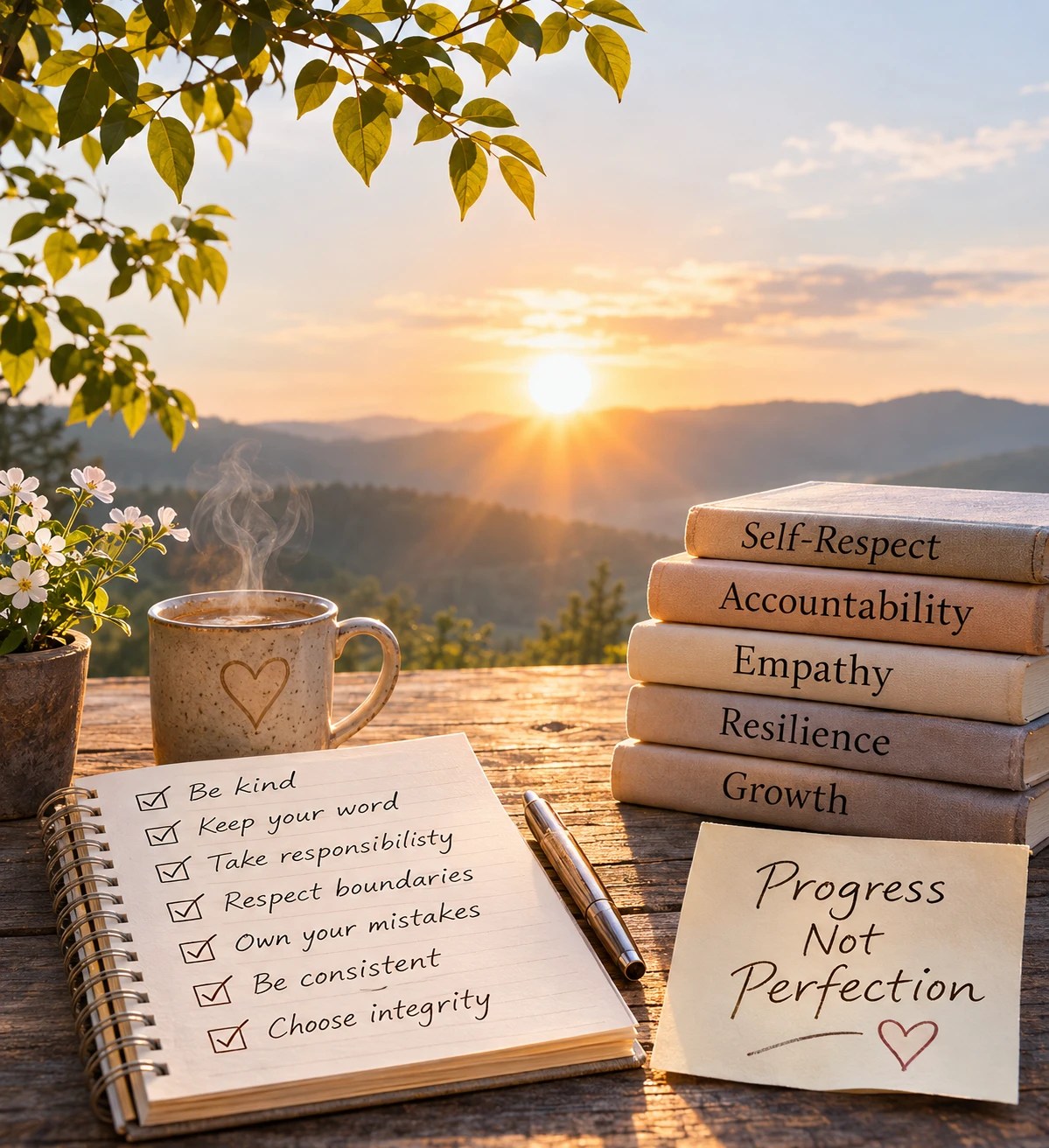
Your character speaks long before you say a word. So does the way you speak to yourself.
Inspired by a thought-provoking YouTube Short from NeuroShade.
Have you ever wondered what people really notice about you?
We tend to assume it is our appearance, our possessions, our job title, or the clever things we say. Yet the impressions that last are usually made in small, ordinary moments: how we act when we are frustrated, whether our promises hold, whether we are kind when nobody important is watching.
You cannot always control what happens to you, but you have considerable influence over how you respond. That is where character lives.
Before We Begin: This Is Not a Scorecard
Some readers will go through a list like this and quietly keep score against themselves. Failed that one. Failed that one too. Proof, once again, that I am not good enough.
If that is you, please hear this first: this post was not written to give you another reason to be hard on yourself. Every point below is something all of us are still learning, including the person who compiled it. Read it as an invitation, not a verdict. And notice that the final point, the one that ties everything together, is about you and the way you treat yourself.
1. How You React When Someone Provokes or Hurts You
Anyone can seem pleasant when things are going their way. Composure is tested when someone insults you, dismisses you, or deliberately pushes your buttons.
This does not mean tolerating disrespect. Being calm is not the same as being passive. You can set a boundary, defend yourself, and state clearly that certain behavior is unacceptable without becoming abusive in return.
Emotional maturity is not the absence of anger. It is the ability to manage anger without letting it manage you. If someone can control your behavior simply by knowing how to upset you, they hold a power you never agreed to give them.
Try This
- Before replying to a provocation, take one slow breath and ask: “What response will I respect tomorrow?”
- Keep one firm, calm sentence ready, such as: “I am willing to talk about this, but not like this.”
- If you do lose your temper, repair it later. One bad moment does not define you.
2. How You Treat People Who Cannot Benefit You
How do you treat someone who cannot advance your career, improve your finances, or introduce you to anyone influential?
Some people ration their kindness according to a person’s perceived importance: charming toward the executive, indifferent toward the receptionist. That is not kindness. It is strategy.
The person cleaning the building deserves the same courtesy as the person who owns it. The waitress, the delivery driver, the elderly neighbor, the stranger asking for directions: all of them are fully human. The true measure of kindness is how you treat people when you have nothing to gain.
Try This
- Learn and use the name of someone who serves you regularly: a doorman, a cashier, a bus driver.
- Say thank you to someone whose work usually goes unnoticed, and mean it.
3. Whether You Keep Your Word, in Small Matters and Large
Trust is built through hundreds of small commitments. You said you would call. Did you? You said you would show up. Did you?
People who make modest promises and reliably keep them become people others can depend on. People who promise big and deliver little lose credibility, and broken trust is slow to rebuild.
Keeping your word does not mean pretending you can do the impossible. When circumstances change, honesty matters: communicate early, explain, and take responsibility. And if you are someone who already carries guilt over every missed commitment, remember that reliability includes being honest about your limits before you say yes.
Try This
- Make fewer promises, and keep the ones you make.
- When you cannot follow through, tell the person before they have to ask.
- Practice saying “Let me check and get back to you” instead of an automatic yes.
4. How You React to Other People’s Success
When someone near you succeeds, what happens inside you? Genuine happiness, or a quiet sting of comparison?
One of the most damaging misconceptions we carry is that someone else’s success shrinks our own. It does not. Another person’s talent does not erase yours. Their recognition does not make your contributions meaningless. There is room in this world for many people to do well.
For people who are hard on themselves, comparison is often where the self-criticism begins. Someone else’s highlight becomes evidence against you. It is not evidence. It is simply their moment.
Try This
- Congratulate someone this week with no “but” attached.
- When comparison stings, ask: “What can I learn from this?” instead of “What does this say about me?”
5. Whether You Truly Listen
Many of us hear without listening. We rehearse our reply while the other person is still talking, interrupt, or steer the conversation back to ourselves.
Real listening takes attention, patience, and curiosity. Sometimes a person does not need advice or your similar story. They need to be heard without being interrupted or judged. Good listeners ask thoughtful questions, remember details, and notice when someone’s feelings do not quite match their words.
Sometimes the greatest gift you can give another person is the feeling that they have truly been heard.
Try This
- In your next conversation, put the phone away and ask one follow-up question before sharing your own view.
- Before offering advice, ask: “Do you want ideas, or do you just need me to listen?”
6. How You Respond When Life Goes Wrong
Relationships end. Jobs disappear. Health falters. Plans collapse. People notice whether you blame everyone else, turn bitter, or let one setback convince you that nothing will ever work out.
Resilience does not mean pretending everything is fine or suppressing grief, fear, or disappointment. It means accepting that hard experiences are part of life without letting any single one write your future. Sometimes the right response is to rest. Sometimes it is to ask for help. Sometimes it is to walk away. Sometimes it is to begin again.
And when things go wrong, notice whether you instinctively blame yourself for everything, including what was never in your control. That is not responsibility. It is an extra weight you do not have to carry.
Try This
- When something goes wrong, sort it into two lists: what I can influence, and what I cannot. Act only on the first.
- Name one person you could ask for help, and reach out before you reach your limit.
7. Whether You Can Admit When You Are Wrong
Some people would rather damage a relationship than admit a mistake. They get defensive, rewrite the story, or insist their intentions matter more than the harm done.
Mature people understand that being wrong is not a catastrophe. It is a chance to learn. A sincere apology sounds something like this:
“I have been thinking about what happened. I was wrong, and I am sorry. I should have handled that differently.”
An authentic apology does not come with excuses or a demand for immediate forgiveness. It acknowledges the harm, accepts responsibility, and shows a willingness to change.
There is an important balance here. Accountability is not self-punishment. You can own a mistake fully, make it right, and then let it go. Replaying it for weeks does not repair anything. It only hurts you.
Try This
- Apologize once, sincerely and specifically, then let your changed behavior do the rest.
- After owning a mistake, ask yourself: “What will I do differently?” Then close the file.
8. How You Speak About People Who Are Not in the Room
How do you talk about someone who is not there to defend themselves? Do you protect their privacy and speak fairly? Or do you exaggerate their mistakes and turn their private life into entertainment?
There are legitimate reasons to discuss someone’s behavior, such as seeking advice or addressing a serious problem. But seeking help is very different from humiliating someone who is absent. And if a person speaks cruelly about others when they leave, why would you assume they speak any differently about you?
Keep this point in mind. We will come back to it.
Try This
- Before repeating something about someone, ask: “Would I say this if they were standing here?”
- When a conversation turns to gossip, gently change the subject.
9. Whether You Respect Boundaries, Including Your Own
Can you accept “no” without taking offense or demanding an explanation? Can you accept that someone is unavailable, or that they see the world differently?
Boundaries are not rejection. They are the conditions that make healthy relationships possible. Respect does not require control. You can care deeply about someone while recognizing that they are an independent human being with the right to make their own choices.
The same applies to you. You are allowed to say no. You are allowed to rest. You are allowed to protect your time and energy without apologizing for existing.
Try This
- The next time someone tells you no, respond with “Okay, thank you for telling me,” and leave it there.
- Set one boundary for yourself this week, and keep it without over-explaining.
10. Who You Are When Nobody Is Watching
It is easy to build a favorable public image. Social media makes it effortless to display generosity and good opinions. But public presentation and private character are not always the same.
Do you tell the truth when a lie would be easier? Do you keep your responsibilities when nobody is checking? Do you do the right thing when a shortcut would never be discovered?
Character is not a performance. It is the sum of the choices we make, including the ones nobody sees. You do the right thing because it is right, not because someone might reward you for it.
Try This
- Do one quiet good deed this week and tell no one.
- Keep one private promise to yourself, as seriously as you would keep a promise to someone else.
11. How You Speak to Yourself: The Voice That Is Always in the Room
Remember point eight, about how we speak of people who are not present? Here is the turn: there is one person who hears every single word you say about them, because they are always in the room. You.
Many good, decent people would never speak to a friend the way they speak to themselves. “I am so stupid.” “I ruin everything.” “Of course I messed it up again.” “Who would want to listen to me?” Words like these, repeated daily, do not make anyone better. They make people smaller, more anxious, and less able to show up for the people who need them.
Humility does not require denying your abilities. Confidence does not require pretending you are flawless. A healthy view of yourself makes room for both. You can admit mistakes without defining yourself by them, and recognize weaknesses without forgetting your strengths.
Imagine a friend coming to you after a serious mistake. Would you tell them they are worthless? Or would you help them see what happened, learn from it, and try again? You deserve that same compassion.
Here is something else worth knowing. The people around you notice how you talk about yourself. When you constantly put yourself down, the people who love you feel it. They wish you could see what they see. Your self-criticism is not a private matter. It affects everyone who cares about you.
Try This
- Catch one harsh thought a day and rewrite it the way you would say it to a friend. “I am useless” becomes “I had a hard day, and I am still learning.”
- At night, write down one thing you did well, however small. Getting through a difficult day counts.
- When someone compliments you, say “Thank you” and stop. No “but,” no correction.
- If the critical voice feels constant or overwhelming, talk to someone you trust, or to a counselor. Asking for support is a sign of strength.
The Bigger Picture: Character Is Built in Everyday Choices
Look at all eleven together and a pattern appears. None of them is about wealth, fame, looks, or titles. They are about emotional maturity, empathy, reliability, humility, resilience, accountability, respect, and integrity. Every one of them is available to every one of us.
You do not need permission to become kinder or more reliable. You can begin with your next conversation, your next disagreement, or your next promise.
And please do not turn these eleven points into a stick to beat yourself or anyone else with. Everyone has hard days, makes mistakes, and sometimes responds poorly. The goal is not perfection. It is becoming a little better than you were yesterday, and being patient with yourself along the way.
Gentle Questions to Carry With You
These are not a test. Take one at a time, and answer honestly, without judgment:
- When someone disrespects me, how do I want to respond?
- Who could use a little more of my kindness this week?
- Is there a promise I need to keep, or one I need to honestly renegotiate?
- Whose success can I celebrate today?
- Am I listening, or waiting for my turn to speak?
- What is one thing within my control right now?
- Is there an apology I owe, or one I have already made and need to stop replaying?
- Do I speak fairly about people who are not present?
- Which boundary, mine or someone else’s, deserves more respect?
- Am I the same person in private that I am in public?
- Would I speak to someone I love the way I speak to myself?
Final Thought: Be Someone Worth Trusting, Starting With Yourself
Possessions lose their shine. Titles change. Recognition fades. What lasts is how we made people feel: respected or dismissed, encouraged or diminished, safe or uncertain.
So treat people with dignity. Keep your word. Listen. Own your mistakes. And extend to yourself the same patience and kindness you would offer anyone you love.
Because the most extraordinary thing people may notice about you is not what you have accumulated or achieved. It is the kind of human being you have chosen to become. And that person deserves to be spoken to with kindness, too.
Inspired by the YouTube Short from NeuroShade, “7 Things People Notice About You,” and expanded into an eleven-part reflection on character, integrity, and self-compassion.
Protecting our Children & Biodiversity’s future towards a more sustainable and habitable Earth!
Compiled & Mr. Alvarez’s Thoughts | AI Enhanced.
Read posts at climatechangecommunity.com
A note on how this post was made: I use AI as a tool to enhance my creativity and thinking. The ideas, intentions, and care behind these words are my own.


Leave a Reply