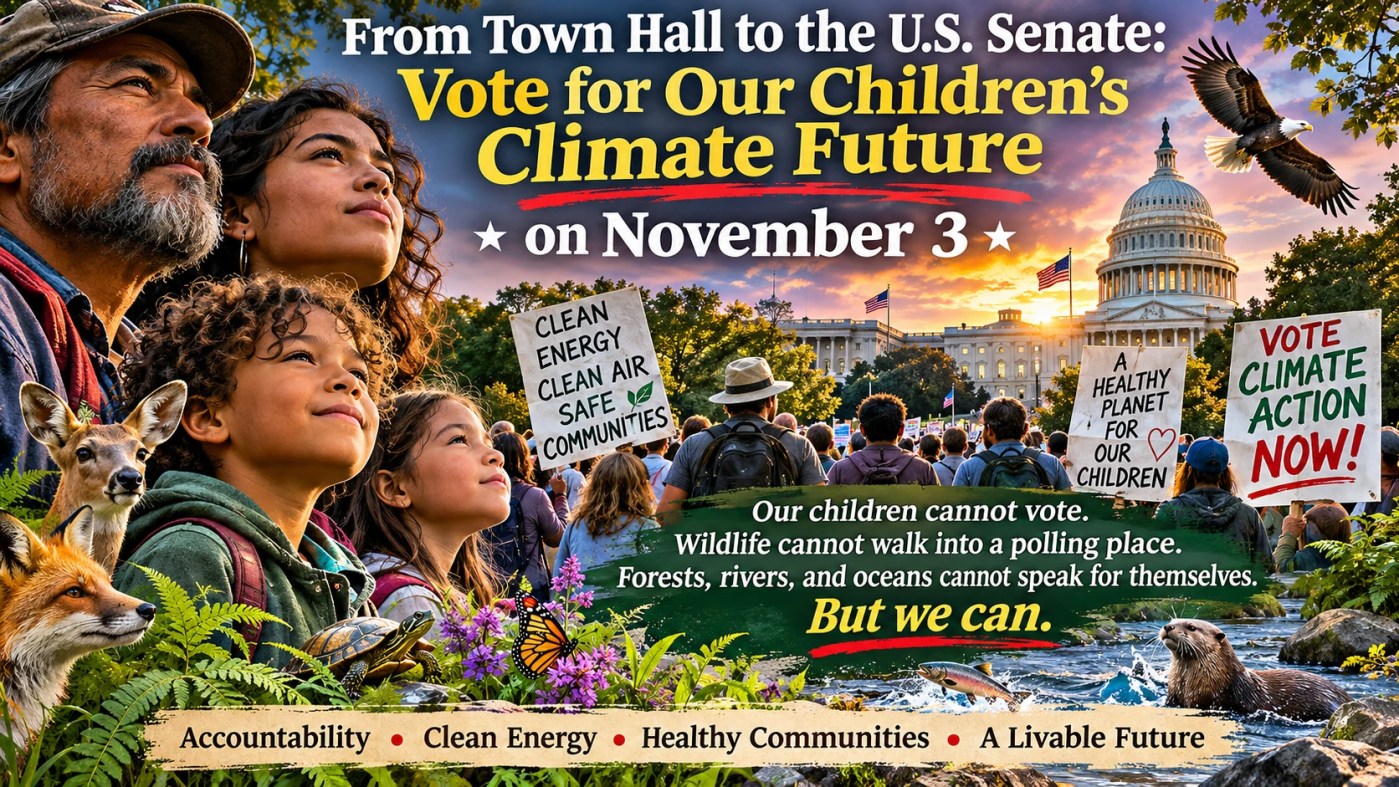
An urgent nationwide appeal for the 2026 midterm elections — two days out.
Our children cannot vote for the future they will inherit. Wildlife cannot walk into a polling place. Forests, wetlands, rivers, and oceans cannot demand that elected officials protect them.
But we can.
On Tuesday, November 3, Americans will decide who writes our laws, who oversees public spending, who holds powerful industries accountable, and whether climate solutions move forward or hit another wall of obstruction. All 435 U.S. House seats are on the ballot, along with U.S. Senate contests, governors’ races, and a long list of state and local offices and ballot measures. The choices differ from place to place. The responsibility does not.
Recent climate and election reporting points to one clear lesson: climate policy is not decided only in presidential years. Local governments turn commitments into projects. States set energy rules. Congress investigates, funds, and blocks. The Senate confirms. Each level holds different tools — and each needs leaders willing to use them.
This November, the defining word is accountability.
Climate Is on the Ballot — Even When Candidates Avoid the Word
Climate can sit at the center of an election even when candidates barely say it out loud. Inside Climate News reports that in 2026, campaigns and advocates are leaning on energy bills, affordability, and data centers rather than explicit climate language — and that mentions of climate change in congressional press releases have dropped sharply over the past year. Surveys of battleground districts show energy costs ranking among voters’ top concerns.
That shift is not a reason to look away. It is a reason to listen more closely.
- When a candidate talks about electricity prices, ask what kind of energy system they plan to build.
- When they promise economic growth, ask who pays for the infrastructure it requires.
- When they champion a giant new data center or industrial project, ask how the public’s air, water, and power bills will be protected.
Advocates are pressing exactly these questions about data centers: how much electricity they demand, whether that demand is met with fossil fuels, and whether large corporate customers will cover their own infrastructure and power costs. Representatives Sean Casten and Mike Levin have proposed legislation addressing energy assistance, large users’ costs, and clean-energy incentives.
No one should have to choose between caring about a livable planet and caring about the monthly utility bill. A campaign slogan is not an energy plan. “Affordability” means little until a candidate explains who benefits, who pays, and what actually gets built.
Start at Town Hall: Where Commitments Become Projects
National headlines make local offices look minor. They are not. The EPA’s archived Local Climate Action Framework lays out a practical sequence: measure emissions, engage residents, set goals, secure resources, implement projects, and report results. A climate commitment means something only when someone turns it into a budget, a schedule, and a public accounting of progress.
For local candidates, ask:
- What climate and resilience goals will you pursue within the real authority of this office?
- What funding and staff will those goals require?
- How will residents help choose priorities?
- How will you measure progress — and explain setbacks?
- How will your promises outlast the press conference?
Town hall should not be where climate ambition disappears into endless discussion. It should be where ambition becomes visible, measurable public service — the everyday work of community resilience.
State Elections Can Open — or Close — the Door
State government may be the most overlooked climate battleground. Inside Climate News points to Illinois, Maine, Michigan, Minnesota, New York, New Mexico, and Virginia as states that passed significant climate or clean-energy laws after one party gained a “trifecta” — control of the governor’s office and both legislative chambers. Without that alignment, a governor’s plans can stall in the legislature, or a legislature’s bills can meet a veto.
The same reporting names Michigan, Minnesota, Wisconsin, Arizona, Pennsylvania, and Nevada as states where this year’s results could reshape what is possible. These are possibilities, not outcomes. Voters decide.
A party label offers context, not a verdict. Not every candidate in one party is a climate champion, and records within each party differ. What the history does show is that control of state institutions has had real policy consequences. Do not skip a state House or state Senate race because it lacks TV coverage. Ask what that candidate would pass, what protections they would defend, and how their positions would shape your state’s energy future.
Congress Matters — Even Without Sweeping New Laws
Honesty first: a more climate-conscious Congress would not automatically produce major new climate laws. It would still face presidential vetoes, and it could not, on its own, return the United States to the Paris Agreement.
But limited power is not zero power. Control of either chamber shapes:
- Oversight: hearings, document requests, and investigations into energy decisions and cuts to scientific institutions.
- Spending: appropriations fights that can block or limit environmental rollbacks.
- Confirmations: the Senate’s vote on who leads federal agencies and who sits on federal courts, including the Supreme Court.
- Groundwork: drafting the legislation a future government can enact.
Stopping damage matters. Exposing misconduct matters. Protecting institutional capacity matters. The choice is not between passing a sweeping climate law tomorrow and doing nothing at all.
Judge Candidates by Their Records, Not Their Branding
“Climate-conscious” should describe a pattern of conduct, not a campaign accessory. Yale Climate Connections recently highlighted a tool that tracks climate-related bills — and how lawmakers voted on them — in 10 states. That is the right standard: what officials have done, not only what they say in October.
Five Things to Check Before You Vote
- Recorded votes and, for executives, actual decisions.
- Specific proposals with real implementation plans.
- How they explain energy costs and protect consumers.
- Their respect for scientific evidence and public oversight.
- Their willingness to own the weak spots in their own record.
Endorsements can point you toward questions worth asking, but they are not a substitute for your own judgment. A candidate who speaks beautifully about future generations should still answer for votes that weaken the protections those generations will need.
Biodiversity Belongs in This Conversation
An appeal focused only on energy would leave out the living world we are trying to protect. The global assessment by IPBES — the intergovernmental science body on biodiversity — identifies climate change as a direct driver that increasingly worsens other pressures on nature and human well-being.
Climate action and biodiversity protection are linked, but not automatically the same. A joint IPBES–IPCC report finds that protecting, restoring, and sustainably managing ecosystems can serve climate mitigation, adaptation, and biodiversity together — while warning of trade-offs when policies chase one goal and ignore the others. Large bioenergy plantations, or planting forests where forests never naturally grew, can harm ecosystems even under a “green” label.
So ask more than whether a proposal is labeled green. Does it protect ecological integrity? Does it account for impacts on habitats and communities? Does it cut emissions without simply moving the damage elsewhere?
Children deserve more than survival in a depleted world. They deserve the chance to know a world rich with other forms of life.
Voting for Children Means Looking Past the Next Election
Politicians invoke children constantly. Children should also set the standard we use to judge them. Ask every candidate what future their policies are actually building — whether their choices reduce risk, protect shared resources, and strengthen the conditions future generations will depend on.
No honest appeal claims one ballot will solve the climate emergency. Nor does one missed opportunity make future action meaningless. The work continues before, between, and after elections. But elections decide who holds the authority to act.
For a ready-made scorecard, the Children’s Environmental Health Network offers a nonpartisan 2026 Voter Guide for Children’s Environmental Health for evaluating local, state, and federal candidates.
Make Your Voting Plan Today — and Read the Whole Ballot
Election Day is two days away. Rules vary by state and locality, so confirm everything with your official state or local election office.
- Confirm your polling place and hours.
- Check ID requirements and any other instructions.
- Review your sample ballot so no office or measure catches you off guard.
- Holding a mail ballot? Check your deadline and drop-off options now. At this late stage, mailing it may not get it there in time — ask your election office about drop boxes or in-person return.
- Share only reliable, official information when helping friends, family, and neighbors.
Run into a problem at the polls? Call the nonpartisan Election Protection hotline: 866-OUR-VOTE (866-687-8683).
Then give the whole ballot the attention it deserves. Weigh what each office can actually do. Look for evidence behind every promise. Read ballot measures in full — not just their titles.
On November 3, Choose Leaders Prepared to Act
Climate progress depends on many powers working together: local implementation, state legislation, congressional oversight, public spending, and Senate scrutiny of appointments. For the Climate Change Community, that is a call to turn climate concern into civic competence.
Vote for leaders who respect evidence. Vote for candidates who can explain their plans. Vote for representatives willing to confront obstruction, protect nature, and report honestly on results.
And after the votes are counted, keep paying attention. Ask what passed. Ask what was funded. Ask what changed. Support real progress — and insist on better where promises go unkept.
Our children cannot cast these ballots. Neither can the species and ecosystems we share this planet with.
On November 3, carry their interests into the voting booth.
Sources
- Inside Climate News — Climate Is on the Ballot, Even if It’s Not in Candidates’ Campaign Messages (Oct. 28, 2026)
- Inside Climate News — Inside Clean Energy: Key State Elections (Sept. 17, 2026)
- Earthjustice — 2026 Election Voting Guide
- U.S. EPA (archived) — Local Climate Action Framework
- Yale Climate Connections — Online Tool Tracks Climate-Related Bills in 10 States (Oct. 2026)
- IPBES — Global Assessment Report, Summary for Policymakers
- IPBES–IPCC — Co-sponsored Workshop Report on Biodiversity and Climate Change
- Children’s Environmental Health Network — 2026 Voter Guide for Children’s Environmental Health
Read posts at climatechangecommunity.com
Protecting our Children & Biodiversity’s future towards a more sustainable and habitable Earth!
Compiled & Mr. Alvarez’s Thoughts | AI Enhanced.
A note on process: Artificial intelligence was used to enhance my creativity and thinking in researching and shaping this post. The convictions, and the responsibility for them, remain my own.


Leave a Reply