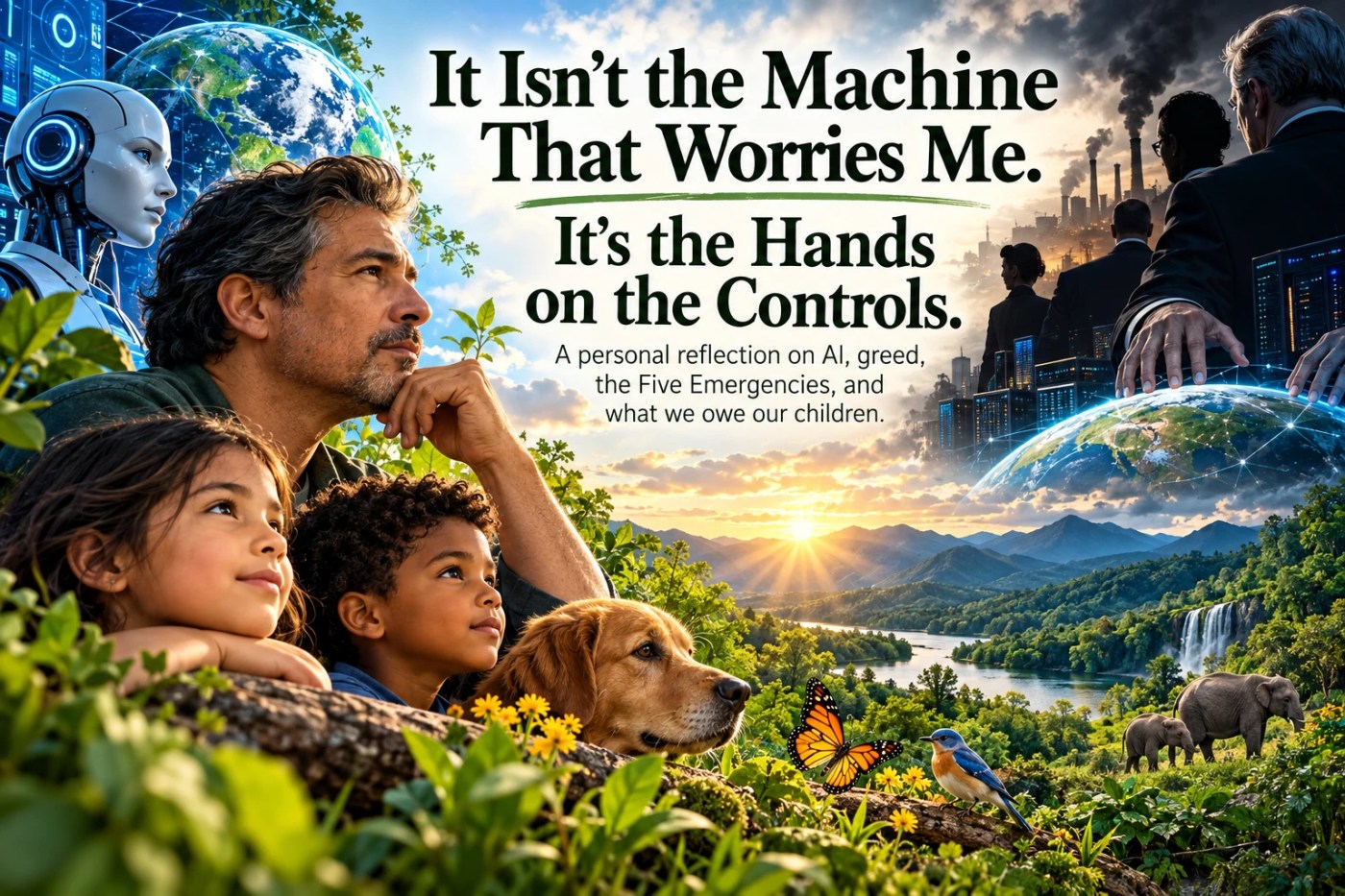
A personal reflection on AI, greed, the Five Emergencies, and what we owe our children
I want to begin with something personal, before any statistics, before any argument. I am worried. Not in the abstract, headline-scrolling way, but in the way that sits in your chest when you think about the children you love and the world they are inheriting.
There is so much confusion right now about artificial intelligence. Uncertainty, animosity, mixed emotions, and a flood of misinformation pulling people in every direction. Some see AI as salvation. Others see it as the end of something precious about being human. I understand both reactions. I feel the pull of both myself.
But here is where I stand, plainly: I believe AI can help humanity evolve toward a world that is sustainable, healthy, and safe for our children and for biodiversity. I use it every day as a partner in my thinking and writing. It does not think for me. It helps me find the words for what is already in my heart.
And yet, I am worried. Because the question that keeps me up is not what AI is. It is who is holding it.
The Real Question: Who Trains It, Who Controls It
The division we feel about AI, the split between hope and dread, does not really live inside the technology. It lives in the back rooms where decisions are made. Who trains these systems? Who manages them? Who controls them, and toward what end?
Are the people who own these platforms acting responsibly? Or are some of them chasing the next biggest and greatest breakthrough with little thought for the well-being of their fellow human beings? These are the questions that should be at the forefront of our public conversation. Not AI itself, per se, but the people and institutions driving it.
A tool reflects the values of the hands that shape it. A hammer can build a home or break a window. AI is far more powerful than a hammer, which means the values behind it matter far more.
Wealth Is Not the Same as Greed
I want to be careful here, because this matters. Wealth and greed are not the same thing. People can build prosperity honestly, and some use their resources to lift others up.
But greed is different. Greed poisons the soul. It affects others in ways both seen and unseen. It destroys and it corrupts. And I cannot shake the feeling that its damage is more visible now than at almost any other point I can remember. I may be wrong about history, but I am not wrong about what I see around me today.
When greed sits at the controls of the most powerful technology humanity has ever built, my worry turns into something closer to fear.
What Naomi Klein Helps Us See
I have long been a big fan of Naomi Klein. For years I have learned from her interviews, articles, and books, because she names the reality of unethical capitalism without flinching. She says out loud what many people feel but struggle to articulate.
In an excerpt from the Reframing Impact series, Klein describes what she calls a toxic love triangle between AI companies, political power, and the fossil fuel industry. Her concern is not simply that computers use electricity. It is that the race to build enormous computing capacity can become a lifeline for fossil fuel infrastructure at the exact moment we need to be leaving it behind.
Importantly, Klein herself separates genuinely beneficial uses, such as medical research and improving renewable energy efficiency, from the massive, shareholder-driven generative AI buildout she criticizes. That distinction is everything. It means this is not a fight between “AI is good” and “AI is bad.” It is a fight over purpose, priorities, and power.
The Energy Problem Is Real, and Honesty Makes It Stronger
Some have claimed AI is “reversing decades of climate progress.” I feel the urgency behind those words. But I also believe we must be precise, because exaggeration hands our critics an easy way to dismiss us.
The International Energy Agency’s 2025 Energy and AI report estimated that data centers used roughly 1.5% of the world’s electricity in 2024, with demand projected to more than double by 2030 and AI as the leading driver. Renewables were projected to meet nearly half of that new demand, but natural gas and coal would supply much of the rest. And globally small numbers can hide enormous local burdens: in Ireland, data centers were already consuming around a fifth of metered electricity.
So no, AI alone has not erased decades of progress. But it is adding a fast-growing demand that makes an already difficult transition harder, at a time when we have no margin left. When governments rush to fast-track data center construction and fossil fuel suppliers line up to power it, those interests reinforce one another. Shareholder expectations should never become a nation’s energy policy.
The Five Emergencies Will Not Wait
At Climate Change Community, we speak about the Five Emergencies: Climate, Ecological, Humanity, Democracy, and Displacement. They are not separate crises. They feed one another. A warming planet displaces families. Displacement strains democracies. Weakened democracies open the door to people who care more about power than about people. And all of it falls hardest on our children and on the living world we depend on.
These emergencies must be faced squarely if humankind is going to continue on this planet. I say that not for drama, but because I have studied this crisis for well over a decade, and I cannot unknow what I know.
Yes, some things are getting better. Clean energy is growing. People are waking up. But progress is not keeping pace with the danger, and far too many people live at the whims of dictators and would-be authoritarians. Elections help break the chains, and they matter enormously. But they do not break them fully on their own.
Change Must Happen Inside Us, and Around Us
Self-Transformation
What does break the chains is self-transformation on a deeper level, in each of us, and most especially in those at the top who hold the most power. I know that kind of change takes time. Hearts do not turn overnight. But it is the only foundation that lasts.
A Shift in What We Value
We also need systemic change in how we place value on things. We have spent generations treating materialism as the measure of success while treating the Earth’s resources as endless and free. That arrangement is collapsing. We must learn to value clean water, healthy soil, living forests, and stable seasons more than the next gadget or the next quarterly earnings report.
A Promise We Could Make Together
Here is what I keep coming back to. What if we created a shared format, a common agreement, where everyone collectively commits to one thing above all else: putting our children’s future and the health of biodiversity as the number one priority?
Not as a slogan. As a guiding test for decisions. Before we build, invest, legislate, or deploy, we ask: does this protect our children and the living world, or does it put them at risk?
Applied to AI, that test would ask:
- What specific problem does this application solve, and does it serve people or just profits?
- What energy and resources does it require, and where does that power come from?
- Who receives the benefit, and who carries the burden?
- Are its owners transparent and accountable to the public?
- What evidence would cause us to limit or stop it?
That is not hostility toward innovation. It is respect for consequences.
Read the Earth Charter Once a Month
One simple practice I believe in: read the Earth Charter once a month. It is a declaration of fundamental ethical principles for building a just, sustainable, and peaceful global society, and it reminds us of what we are actually trying to protect. Alongside it, I encourage reading the humanitarian work of the most influential thinkers the world has known, those whose wisdom has stood the test of time, rather than those who loudly claim to have all the answers while steering us toward a more uncomfortable reality.
Monthly reflection may sound small. But habits shape hearts, and hearts shape choices.
Assistance, Not Abdication
I want to be honest about how I use AI, because I believe honesty is part of accountability. The concern for our children is mine. The commitment to biodiversity is mine. The decision to speak publicly is mine. AI helps me organize my thoughts and express them more clearly, but it is not the source of my conscience.
If a tool only flatters my assumptions, it is not strengthening my voice. It is just polishing my blind spots. So I check claims, I keep uncertainty visible, and I take full responsibility for every word I publish.
And using AI does not mean I must stay silent about how it is governed. Participation is not a promise of silence.
Our Children Do Not Need Digital Gods
I hope I am able to express myself freely here, because this comes from a worried heart, not a polished pitch. I am not against the technology. I am afraid of what greed can do with it, and I am afraid of how little time we have left to get this right.
Our children do not need us to win an argument about whether AI is good or bad. They need us to make sure the people building and controlling it do not sacrifice the living world for its expansion.
Let the tool help us find the words. Let human conscience, evidence, and our responsibility to one another decide what we do with them.
Read posts at climatechangecommunity.com
A note on process: AI is used to enhance my creativity and thinking. The convictions, concerns, and responsibility for these words are my own.
“Unless I accept my faults, I will most certainly doubt my virtues.” – Hugh Prather
Protecting our Children & Biodiversity’s future towards a more sustainable and habitable Earth!
Compiled & Mr. Alvarez’s Thoughts | AI Enhanced.
Mr. Alvarez, Content Curator, Climate Change Community LLC


Leave a Reply