Test blog post… testing local-based AI…
Why self-preservation and collective preservation are no longer separate projects, and how neighborhoods can begin the work this week
There is a quiet question sitting underneath most conversations about the Climate and Ecological Emergency right now. It is not “Is this real?” Most of us have moved past that. The question is closer to this: “What am I supposed to do about it, and who is going to help me?”
For a long time, the default answer was that someone else would handle it. Governments would negotiate treaties. Agencies would write plans. Markets would invent solutions. Our job was to recycle, vote, and wait. That answer is no longer enough, not because institutions are useless, but because the pace of disruption has outrun the pace of institutional response. The gap between what is happening and what is being done is where ordinary people now live.
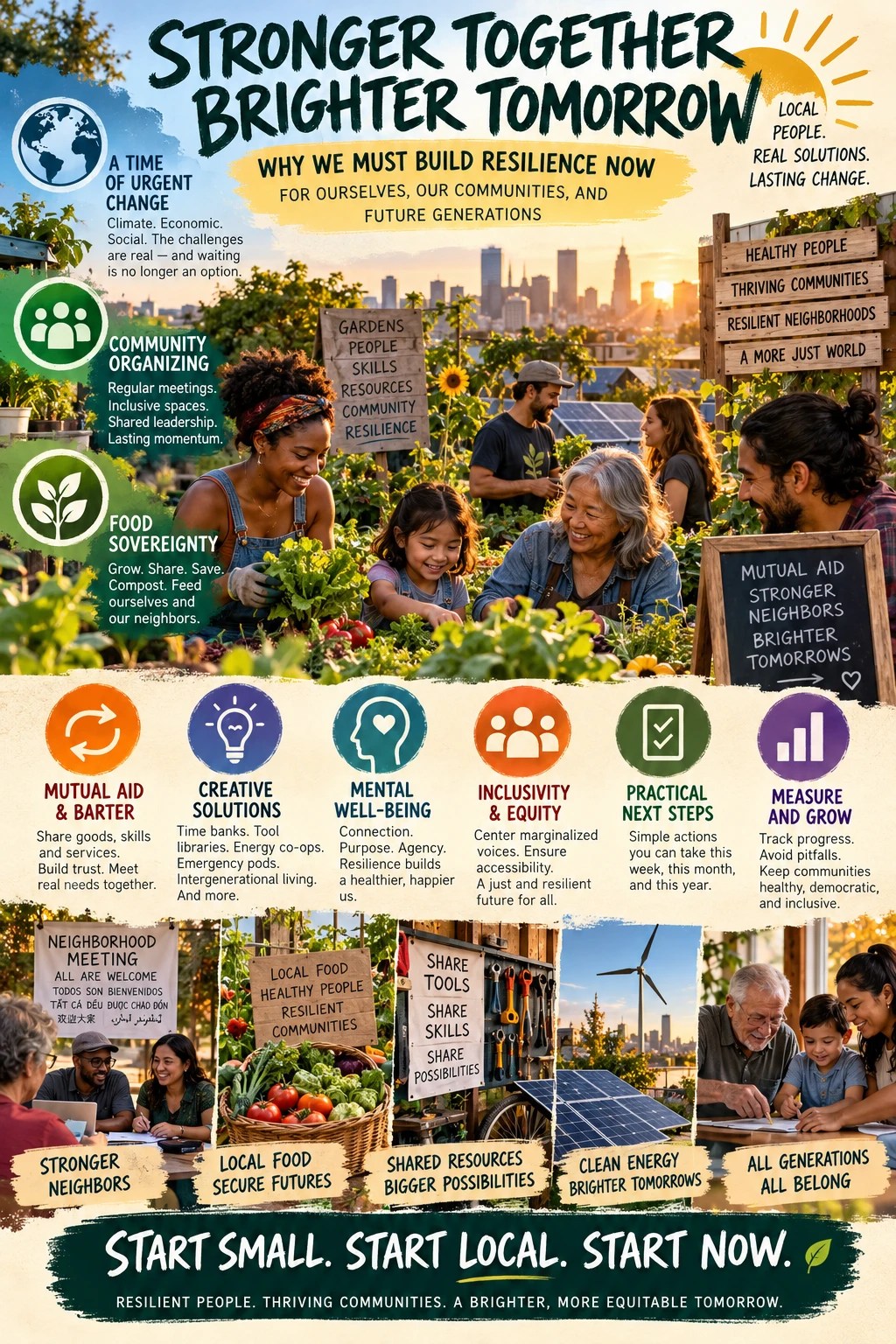
This post is about filling that gap. It is about why we need to begin adapting and building resilience now, through strategies that protect ourselves and our households (self-preservation) while strengthening the people around us (collective preservation). These are not competing goals. In practice, they are the same goal viewed from two distances.
The Urgency of the Moment
What we can actually observe
You do not need dramatic forecasts to see the trend lines. You can see them in your own life and your own neighborhood. Heat waves arrive earlier and stay longer. Storms that used to be described as once-in-a-generation now show up on the news every season. Flooding reaches streets and basements that never flooded before. Insurance companies are raising premiums or pulling out of entire regions. Grocery prices swing with droughts and crop failures on the other side of the world. Wildfire smoke drifts across hundreds of miles and turns city skies orange.
Alongside the physical changes come economic and social strains: housing costs that push families further from work and support networks, aging infrastructure, overstretched public health systems, and a growing sense of isolation that many people describe even when they live surrounded by neighbors. None of this requires exaggeration. It is the texture of everyday life for millions of people.
Why waiting is no longer a strategy
Governments and large institutions still matter enormously. Policy shapes energy systems, building codes, disaster funding, and public health. We should keep pushing for better policy. But institutions are slow by design. They move through budget cycles, election cycles, legal reviews, and political negotiation. Disasters do not wait for any of those cycles.
When Hurricane Sandy struck New York in 2012, many of the first people to reach isolated residents in high-rise buildings were not official responders. They were neighbors, volunteers, church groups, and grassroots networks, including the volunteer effort that became known as Occupy Sandy, carrying water and medicine up dark stairwells. After Hurricane Maria in Puerto Rico in 2017, community kitchens and mutual aid centers organized by residents kept people fed for weeks while official aid struggled to arrive. These are not stories about government failure alone. They are stories about what happens in the first hours, days, and weeks of any crisis: the people nearest to you are the people who can help you.
Researchers who study disasters have pointed to this for years. Political scientist Daniel Aldrich’s work on disaster recovery has emphasized social ties, the trust and connections between neighbors, as one of the strongest predictors of how well communities recover. Sociologist Eric Klinenberg’s study of the 1995 Chicago heat wave found that social isolation was a major factor in who survived and who did not. The lesson is consistent: relationships are infrastructure.
That is the heart of the urgency. Resilience built after a crisis begins is improvised and fragile. Resilience built before a crisis is practiced, trusted, and ready.
Community Organizing Fundamentals
Every resilient community begins the same way: people meeting regularly, getting to know one another, and making decisions together. It sounds simple. It is also the step most often skipped.
Regular meetings, neighborhood councils, and coordination bodies
A neighborhood resilience group does not need to be formal at first. It can start as a monthly gathering in a living room, a library meeting room, a house of worship, a community center, or a park. Over time, some groups formalize into neighborhood councils or coordination bodies that work with tenant associations, block associations, local schools, and small businesses.
Many places already have structures you can plug into rather than reinvent: tenant unions, community boards, civic associations, faith networks, and Community Emergency Response Team (CERT) programs, which train residents in basic disaster response. The free FEMA Independent Study courses on incident command and emergency management are another useful foundation for anyone who wants to understand how official response systems work and where community groups fit alongside them.
Frequency and rhythm
A practical rhythm for most groups is a monthly general meeting, with smaller working groups (food, communications, preparedness, care) meeting more often as needed. Monthly is frequent enough to build familiarity and slow enough to be sustainable. Seasonal events, such as a spring seed swap, a summer heat-safety check-in, or a fall preparedness fair, give the year a natural shape and give newcomers easy entry points.
Facilitation that keeps everyone in the room
Good facilitation is a skill, and it can be learned. A few habits make a big difference:
- Rotate roles. Facilitator, note-taker, and timekeeper should rotate so no single person becomes the group.
- Start with check-ins. A short round of names and one sentence each builds familiarity and lowers the barrier for quieter people.
- Publish an agenda in advance and end on time. Respecting people’s time is the fastest way to earn their return.
- Record decisions, not just discussions. Every meeting should end with who is doing what by when.
- Use simple decision methods. Consent-based decision-making (“Can everyone live with this?”) often works better for small groups than majority voting.
Inclusivity across languages and cultures
A resilience group that only speaks one language in a multilingual neighborhood will only ever reach part of that neighborhood. Plan for interpretation from the start, whether through bilingual volunteers, whisper interpretation at a side table, or translated meeting notes. Hold meetings at varied times so shift workers and caregivers can attend. Provide food and, where possible, childcare. Ask local cultural and faith leaders not just to attend but to help shape the agenda. People show up where they feel they belong.
Maintaining momentum without burnout
Burnout is one of the most common ways community efforts die. It usually happens when a few dedicated people carry everything. Protect against it by keeping commitments small and specific, celebrating small wins publicly, building in seasonal rest periods, and making it normal for people to step back without guilt. A group that can survive the temporary absence of its most active members is a resilient group. A group that collapses when one person gets tired was never resilient to begin with.
Food Sovereignty at Home and Neighborhood Level
Food sovereignty means communities having meaningful influence over how their food is grown, shared, and distributed. It does not mean every household must feed itself entirely. That is neither realistic nor necessary. It means reducing total dependence on long, fragile supply chains and building local capacity that can soften shocks.
Home and balcony gardens
Even a small amount of growing changes how people relate to food. A sunny windowsill can grow herbs. A balcony can support tomatoes, peppers, beans, and leafy greens in containers. Fabric grow bags, vertical planters, and railing boxes make the most of tight spaces. The point is not only the harvest; it is the knowledge and confidence that come from growing anything at all.
Community plots
Community gardens turn vacant lots, schoolyards, church grounds, and rooftops into shared growing space. Many cities have community garden programs that help groups secure land access. Beyond food, these gardens become meeting places, teaching spaces, and informal emergency hubs where people already know one another.
Hydroponics and indoor growing
For people with no outdoor space at all, simple hydroponic systems, such as the passive Kratky method or small countertop units, can grow lettuce and herbs indoors year-round. These systems do require some electricity for grow lights and a modest learning curve, so they work best as a supplement and a teaching tool rather than a primary food source.
Seed saving and seed libraries
Saving seeds from open-pollinated plants preserves varieties adapted to local conditions and reduces dependence on commercial suppliers. Seed libraries, often hosted by public libraries, let people “borrow” seeds in spring and return saved seeds in fall. A neighborhood seed swap is one of the easiest and most joyful events a new resilience group can host.
Composting
Composting turns food scraps into soil, closing the loop between kitchen and garden. Options range from backyard bins and worm bins (vermicomposting, which works well in apartments) to bokashi fermentation and municipal or community drop-off programs. Shared compost at a community garden is an easy first collaboration between neighbors.
Overcoming common barriers
- Limited space: Start with herbs and greens, which produce a lot in little space. Pool resources with neighbors who have yards.
- Rental restrictions: Use movable containers, ask landlords about shared courtyard beds, or join a community garden. Many landlords say yes when asked respectfully with a clear plan.
- Lack of knowledge: Pair beginners with experienced growers. Elders in many communities carry generations of growing knowledge and are often delighted to share it.
- Cost: Seed swaps, shared tools, and recycled containers bring costs close to zero.
- Soil contamination in urban areas: Test soil before planting in the ground, and use raised beds with clean soil when needed.
Mutual Aid and Barter Systems
Mutual aid is the practice of people meeting each other’s needs directly, as equals, rather than through charity that flows one way. The phrase “solidarity, not charity” captures the spirit: everyone gives, everyone receives, and no one is reduced to a recipient. During the COVID-19 pandemic, thousands of neighborhood mutual aid groups formed across the world almost overnight, organizing grocery deliveries, check-in calls, and emergency funds. Many still exist.
What can be exchanged
Trust-based exchange networks can cover far more than goods. Consider skills (repairs, tutoring, tax help, translation), childcare swaps between families, elder care support such as rides to appointments and daily check-ins, meal sharing, pet care, and help moving or cleaning after storms. The most valuable exchanges are often the ones that never had a price tag.
Record-keeping and informal credit
Small groups can run on trust and memory. As they grow, light record-keeping prevents misunderstandings. A shared spreadsheet or simple app can track offers, requests, and completed exchanges. Some groups use informal credit systems where members earn and spend credits, or simply track hours given and received. The goal is not strict accounting; it is visibility, so that no one feels taken advantage of and no one quietly gives until they are depleted.
Preventing exploitation and power imbalances
Any exchange system can reproduce the inequalities around it if no one pays attention. Watch for these patterns:
- The same few people always giving while others only receive, or the reverse.
- Certain kinds of labor (often care work done by women) being treated as less valuable than technical or physical labor.
- People with more resources quietly gaining influence over decisions.
- Vulnerable members feeling unable to say no to requests.
Build in safeguards: clear consent for every exchange, background checks or vouching for anyone providing care to children or elders, rotating coordinators, and open conversations about fairness at regular meetings. Mutual aid works best when it is understood as a relationship, not a transaction.
Out-of-the-Box Innovations
Beyond gardens and meetings, communities around the world are experimenting with creative structures that make resilience part of daily life. None of these require waiting for permission.
Time banks and skill-sharing economies
In a time bank, every hour of service is worth the same, whether it is legal advice or dog walking. Members earn time credits by helping others and spend them when they need help. The modern time bank movement owes much to the late legal scholar Edgar Cahn, who championed the idea that everyone has something valuable to contribute. Time banks are especially powerful for people who are rich in skills and time but short on cash.
Emergency preparedness pods
A preparedness pod is a small, trusted group, perhaps three to eight households, that agrees to support each other in a crisis. Pod members share contact lists and emergency plans, know who has medical needs or mobility challenges, agree on meeting points, and pool supplies like water, flashlights, first aid kits, and backup power. Pods are small enough to stay personal and large enough to cover each other’s gaps. A neighborhood can be woven together from many pods that coordinate through a larger group.
Tool libraries and shared resource hubs
Most households own tools they use a few times a year. Tool libraries let members borrow drills, ladders, garden equipment, and repair tools instead of each buying their own. The Berkeley Tool Lending Library in California has operated since the late 1970s, and tool libraries have since spread to many cities. The same model works for camping gear, generators, dehumidifiers, sewing machines, and kitchen equipment for large gatherings. Shared hubs reduce costs, reduce waste, and give neighbors a regular reason to meet.
Intergenerational living arrangements
Isolation is a quiet risk in every crisis, especially for older adults living alone. Intergenerational arrangements, such as home-sharing programs that match older homeowners with younger renters, multigenerational households, and co-housing communities, pair people who need affordable housing with people who need companionship and help. A well-known example from the Netherlands, the Humanitas care home in Deventer, invited university students to live rent-free in exchange for spending time with elderly residents. These arrangements need clear agreements and good matching, but they turn two vulnerabilities into a shared strength.
Energy co-ops and microgrid experimentation
Community energy cooperatives let residents jointly own solar installations and share the benefits. Community solar programs allow renters and people without suitable roofs to subscribe to shared solar arrays. Microgrids, which can keep power flowing to a building or block when the main grid goes down, are moving from experiment to practice. In Brooklyn, the Brooklyn Microgrid project explored how neighbors could buy and sell locally generated solar power. Even smaller steps help: a shared battery bank and a few portable solar panels at a community center can keep phones charged, medications cold, and communication flowing during an outage.
Digital platforms that coordinate without centralizing
Technology can help neighbors find each other, but it can also create single points of failure and control. Favor tools that are simple, widely accessible, and owned by the community where possible: group messaging apps, shared calendars, open-source coordination platforms, and federated social networks that do not depend on one company. Always keep a non-digital backup, such as a printed phone tree, a bulletin board, and agreed meeting places, because the moments we most need coordination are often the moments the internet fails. Artificial intelligence can also be a useful helper here, translating notices, summarizing meetings, and organizing resources, as long as humans remain in charge of decisions and trust stays rooted in relationships.
Language-accessible communication networks
Emergency information that only arrives in one language leaves people behind. Communities can build multilingual phone trees, train bilingual “language captains” for each block or building, translate key preparedness materials in advance, and use visual symbols and audio messages for people with low literacy. When an alert goes out, it should reach everyone in a language they understand, through a person they trust.
The Psychological and Emotional Dimensions
Let us be honest about something: many people feel afraid. Climate anxiety, eco-grief, and a general sense of overwhelm are widespread, and they are reasonable responses to a genuinely difficult situation. Some people cope by not looking at all. Others look constantly and feel paralyzed. Neither response is a character flaw.
What helps is not more information alone. It is agency, purpose, and connection. Psychologists who study climate distress frequently note that taking meaningful action, especially action alongside others, is one of the most effective ways to ease anxiety. When you plant something, attend a meeting, check on a neighbor, or help build a preparedness pod, you shift from being someone things happen to into someone who is doing something. That shift matters.
Resilience work also rebuilds connection, which is itself protective. Loneliness erodes health and wellbeing in ways comparable to other well-known risk factors. A neighborhood where people know each other’s names is not only better prepared for storms; it is a better place to live on an ordinary Tuesday.
A few principles help keep this work emotionally healthy:
- Make room for feelings. Some groups open meetings with a brief space to name how people are doing. Grief and fear shared are lighter than grief and fear carried alone.
- Focus on what is within reach. You cannot fix the global climate system this week. You can make sure your neighbor has a working flashlight.
- Celebrate progress. Small wins are not trivial. They are evidence that change is possible.
- Know when to seek support. If anxiety becomes overwhelming, talking with a counselor or mental health professional is a sign of strength, not weakness.
Inclusivity and Equity
Resilience that protects only the comfortable is not resilience. It is just a better-insulated version of the same inequalities that make crises so deadly in the first place. Disasters consistently hit hardest among low-income communities, communities of color, disabled people, older adults, immigrants, and people without stable housing. Any serious resilience effort has to start with them, not add them at the end.
Center marginalized voices
This means more than inviting people to meetings. It means asking those most affected to help set priorities, sharing leadership, compensating people for their time when possible, and listening when they say an approach will not work for them. People who have lived through hardship often know more about survival than any expert.
Accessibility for disabled residents
Hold meetings in accessible spaces. Offer remote participation options. Provide materials in large print, plain language, and accessible digital formats. In preparedness planning, identify residents who depend on electricity for medical devices, who use wheelchairs, who are deaf or blind, or who need medication refrigeration, and build specific plans with them, not for them. Disability-led organizations have deep expertise here, and partnering with them strengthens everyone.
Avoid privileging wealth and property
It is easy for resilience efforts to become organized around homeowners, people with yards, people with cars, and people with flexible schedules. Watch for this. Renters, shelter residents, and people experiencing homelessness are part of the community too. Design programs so that participation does not require owning anything. A tool library, a time bank, and a community fridge all work for people with very little.
Watch for gatekeeping
Exclusion often happens quietly: meetings held only in one language, decisions made in private group chats, insider jargon, or expectations of a certain kind of politeness. Regularly ask, “Who is not here, and why?” Then go find out.
Practical First Steps
Big change starts with small, specific actions. Here is a ladder of steps, scaled from individual to household to neighborhood. Pick one rung and begin.
This week
- Individual: Plant one herb on a windowsill. Basil, mint, or scallions regrown from kitchen scraps are easy starts.
- Individual: Write down the phone numbers of three neighbors and save them somewhere that does not depend on your phone.
- Household: Assemble a basic emergency kit with water, nonperishable food, a flashlight, batteries, a first aid kit, copies of key documents, and any essential medications. Ready.gov has free, clear checklists.
- Household: Talk with the people you live with about what you would do in a power outage, heat wave, or flood.
- Neighborhood: Introduce yourself to one neighbor you do not know yet.
This month
- Individual: Take one free course, such as basic first aid, CPR, or an introductory FEMA Independent Study course.
- Household: Host a potluck and invite neighbors to talk about what they worry about and what they are good at.
- Household: Start composting, whether through a worm bin, a backyard bin, or a local drop-off program.
- Neighborhood: Form a preparedness pod with a few trusted households. Share contact information and identify who might need extra help.
- Neighborhood: Find out what already exists nearby, including community gardens, tenant associations, CERT teams, food pantries, and mutual aid groups, and connect with them.
This year
- Individual: Learn one practical skill deeply, such as food preservation, basic home repair, gardening, or a second language spoken in your neighborhood.
- Household: Grow a meaningful portion of your herbs and greens, and save seeds from at least one plant.
- Neighborhood: Map local assets, including people with skills, spaces for gathering, sources of water and power, vulnerable residents, and existing organizations. An asset map shows you what you already have, which is often far more than you expected.
- Neighborhood: Launch one shared resource, such as a tool library, seed library, time bank, or community fridge.
- Neighborhood: Hold a preparedness drill or tabletop exercise so the plan is practiced, not just written.
Common Objections and Thoughtful Responses
Skepticism is healthy. Here are some of the most common concerns, taken seriously.
“I don’t have time.”
This is real. Many people are working multiple jobs, caring for children or parents, and running on empty. Resilience work should not become one more obligation that crushes people. The good news is that the most useful steps are small: knowing your neighbors, keeping an emergency kit, joining a group that meets once a month. Over time, resilience can actually save time, as when a neighbor watches your kids, a tool library saves you a trip to the store, or a pod shares the work of storm prep.
“One person can’t make a difference.”
One person alone cannot stop climate change. But resilience is not built by one person alone. It is built by one person who talks to another, who invites a third. Every community group that exists today started with a handful of people. And for the neighbor you check on during a heat wave, your one action may make all the difference.
“This sounds cultish.”
It is wise to be cautious about any group that asks for loyalty, money, or isolation. Healthy resilience groups look nothing like that. They are open, transparent, voluntary, and easy to leave. They encourage members to keep their outside relationships, think for themselves, and disagree openly. If a group discourages questions or concentrates power in one leader, that is a reason to step back. The section below on red flags is designed precisely for this.
“Government should handle this.”
Government should do much more, and community resilience is not a substitute for good public policy. Keep voting, advocating, and holding officials accountable. But community action and public action reinforce each other. Organized neighborhoods are better at securing public resources, giving input on plans, and making sure aid reaches the people who need it. Emergency managers themselves often stress that individual and community preparedness are essential parts of any response, because official responders cannot be everywhere at once.
“It’s too late anyway.”
It is too late to prevent all harm. It is not too late to reduce harm, protect people, and shape what comes next. Every fraction of a degree of warming avoided matters, and every community that prepares will suffer less and recover faster than one that does not. “Too late” is not a single moment; it is a range of outcomes, and our choices still move us across that range. Despair is understandable, but it is not a plan.
Measuring Success and Avoiding Pitfalls
How do you know your community’s resilience work is on the right track? Not by size alone, and not by how busy everyone is. Look for these signs.
Signs of healthy growth
- New people keep joining, and newcomers move into leadership roles.
- More people know their neighbors’ names and needs than a year ago.
- The group reflects the diversity of the neighborhood in language, age, income, and ability.
- Responsibilities are spread out, and the group functions when key members are away.
- Disagreements are discussed openly and resolved respectfully.
- Members report feeling less anxious, more connected, and more capable.
- When a real disruption happens, such as an outage, a storm, or a family emergency, the network actually activates and helps.
Signs of unhealthy dependency
- A few people do nearly everything, and the group stalls without them.
- Members expect the group to solve problems rather than participate in solving them.
- The same households always receive, and no pathway exists for them to contribute in ways that feel meaningful.
Red flags for authoritarian drift
- One person or small circle makes decisions without input or transparency.
- Questions, dissent, or criticism are discouraged or punished.
- Members are pressured to cut ties with outside friends, family, or institutions.
- Money or resources are handled without clear records.
- The group frames outsiders, or particular groups of people, as enemies.
- Fear is used to motivate rather than care.
- Leaving the group is made difficult or shameful.
Healthy resilience is open-handed. It strengthens people’s independence and their connections at the same time. If your group starts to feel like a fortress rather than a front porch, pause and reassess together.
Start Small, but Start Now
Self-preservation and collective preservation are not opposing instincts. Your household is safer when your neighborhood is strong, and your neighborhood is strong when each household is prepared. The emergency kit in your closet and the potluck on your block are part of the same project.
You do not need to become an expert, quit your job, or solve everything at once. You need to take one step, and then another, and invite someone to take the next one with you. Plant the herb. Learn your neighbor’s name. Host the potluck. Join the meeting. Map what your community already has. This is how climate concern becomes climate competence: not through one grand gesture, but through many small acts of preparation, care, and cooperation, repeated until they become the way we live.
The moment calls for courage, but it is the quiet, practical kind: the courage to knock on a door, to ask for help, to offer it, and to keep showing up. We are going to face what is coming either way. Let us face it together, and let us start now.
Read posts at climatechangecommunity.com
A note on how this post was made: AI was used to enhance my creativity and thinking in compiling this piece. The ideas, values, and commitments behind it are my own.
Protecting our Children & Biodiversity’s future towards a more sustainable and habitable Earth!
Compiled & Mr. Alvarez’s Thoughts | AI Enhanced.


Leave a Reply