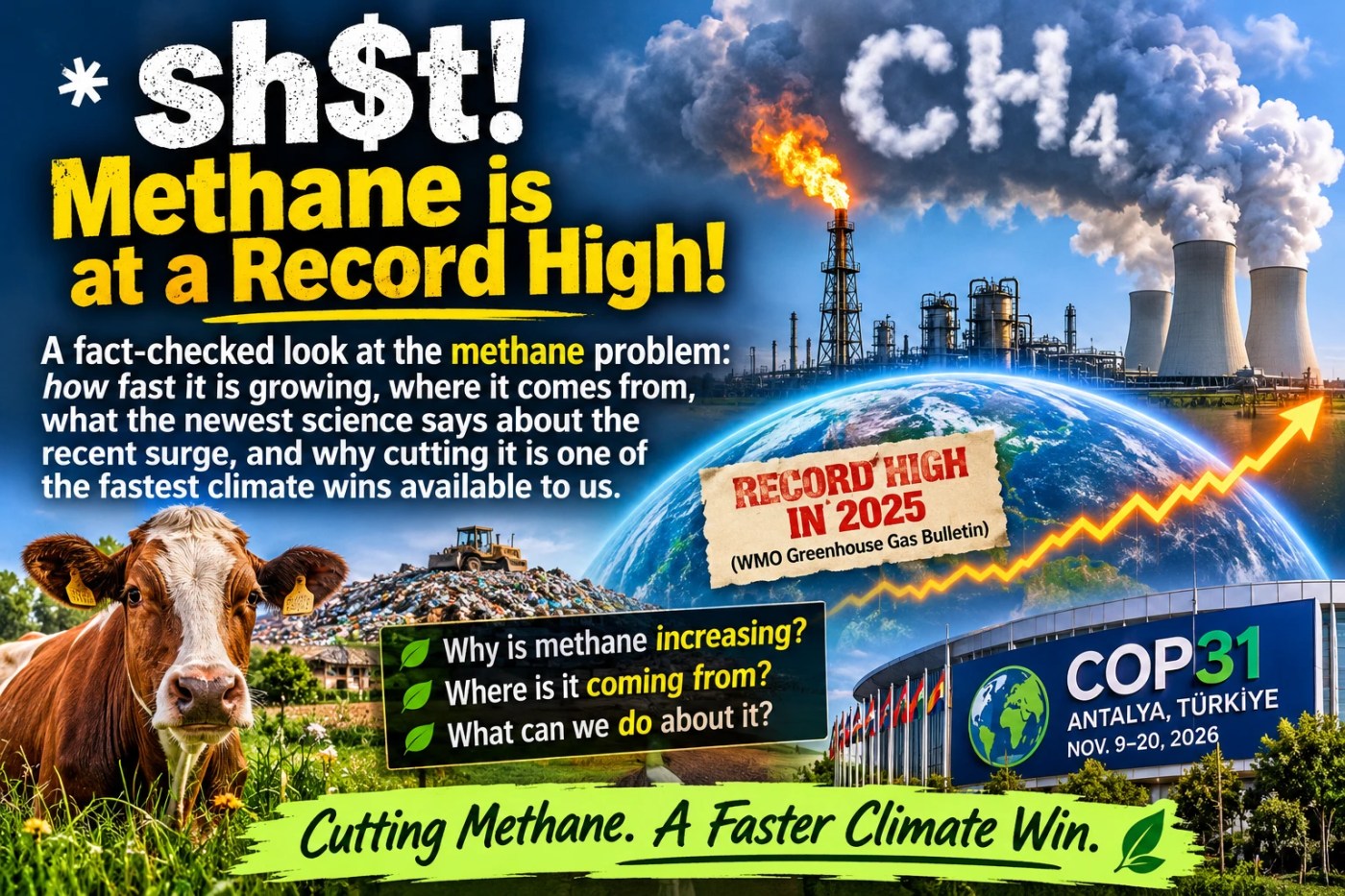
Forget Halloween, this is some scary sh$t!
A fact-checked look at the methane problem: how fast it is growing, where it comes from, what the newest science says about the recent surge, and why cutting it is one of the fastest climate wins available to us.
There is a climate story that deserves far more public attention than it gets. Methane concentrations in Earth’s atmosphere are at a record high, and they keep climbing. On October 27, 2026, the World Meteorological Organization confirmed it again in its annual Greenhouse Gas Bulletin: carbon dioxide, methane and nitrous oxide all set new records in 2025.
We hear a great deal about carbon dioxide (CO₂), and rightly so. CO₂ is the principal driver of long-term human-caused warming. But methane (CH₄) is a far more powerful heat-trapper over the short term, and what we do about it in this decade will shape how much warming our children live through.
With world leaders gathering in Antalya, Türkiye, for COP31 from November 9–20, this is the right moment to ask: Why is methane increasing? Where is it coming from? And what can we actually do about it? Let’s look at the evidence.
1. Is methane really rising? Yes — and here are the numbers
Measurements from the National Oceanic and Atmospheric Administration (NOAA) and the World Meteorological Organization (WMO) both confirm that atmospheric methane is at the highest level ever recorded.
- About 2.7 times preindustrial levels. The WMO puts the 2025 global average at 267% of the 1750 level.
- 1,948 ppb (parts per billion) — WMO, 2025. Published in Greenhouse Gas Bulletin No. 22, October 2026.
- About 1,935 ppb — NOAA, 2025. NOAA’s marine-surface network reads slightly lower because it samples remote background air, while the WMO also includes inland stations. The two figures are not directly interchangeable, but both point in the same direction: up.
The acceleration, and the recent slowdown
NOAA’s Global Monitoring Laboratory reports the following average annual increases:
| Period | Average annual increase |
| 2010–2014 | 6.7 ppb per year |
| 2015–2019 | 8.5 ppb per year |
| 2020–2024 | 12.4 ppb per year |
| 2025 (single year) | 4.8 ppb |
Source: NOAA Global Monitoring Laboratory, annual increase table (data version 2026-10).
One important qualification: growth has slowed considerably since the record surge of the early 2020s. NOAA records an increase of 17.69 ppb in 2021 — the largest in its record going back to 1984 — compared with 4.77 ppb in 2025.
That is encouraging in one respect, but it does not mean methane is declining. Every year that number stays above zero, more methane is piling up in the atmosphere. We have not solved the problem; we are seeing a slower rate of accumulation. And as Section 4 explains, part of that slowdown came from atmospheric chemistry, not from anything we did.
2. Why is methane so dangerous?
Methane is the main component of natural gas, but it is also produced by microbes in wetlands, landfills, rice paddies and the stomachs of cattle. Like CO₂, it absorbs heat leaving Earth’s surface and traps it in the atmosphere. What makes it different is how hard it hits, and how briefly it lingers:
- Over 20 years, a ton of methane causes roughly 80 times as much warming as a ton of CO₂ (IPCC Sixth Assessment Report).
- Over 100 years, it causes roughly 27–30 times as much.
- It lasts about a decade in the atmosphere (estimates range from about 9 to 12 years depending on how it is measured), while CO₂ can influence the climate for centuries.
Methane is the short, sharp punch; CO₂ is the long, heavy weight. That is exactly why cutting methane delivers climate benefits quickly. It does not mean we can ignore carbon dioxide. We must tackle both.
According to the International Energy Agency (IEA), methane is responsible for roughly 30% of the rise in global temperatures since the Industrial Revolution. The WMO estimates it accounts for about 16% of the current warming effect of all long-lived greenhouse gases.
3. Where is all this methane coming from?
Methane does not come from one industry or one source. It comes from both human activity and natural systems, and the two increasingly interact.
A. Livestock and agriculture
Cattle, sheep and other ruminants produce methane during digestion, a process called enteric fermentation. Their manure releases more, particularly when stored in liquid lagoons. Flooded rice paddies are another major source, because oxygen-poor water lets methane-producing microbes thrive.
B. Oil, gas and coal
Methane escapes during the extraction, processing, transport and storage of fossil fuels: leaking pipelines, poorly maintained equipment, intentional venting, incomplete flaring, coal mines, and abandoned wells. The IEA’s Global Methane Tracker 2026 estimates the energy sector released about 124 million tonnes of methane in 2025 and found no sign that those emissions fell. This is especially frustrating, because much of it can be prevented with existing technology.
C. Landfills and waste
When food scraps, paper and yard waste decompose without enough oxygen, they generate methane. Landfills release substantial quantities unless that gas is captured and managed.
D. Wetlands and other natural sources
Wetlands and inland waters are the largest single source of methane on Earth. Microbes break down organic matter in waterlogged, oxygen-poor soils, and changes in rainfall, temperature and flooding can sharply change how much they release. Tropical wetlands are especially important.
E. Thawing permafrost
As Arctic soils warm, long-frozen organic material becomes available for decomposition and can release both CO₂ and methane. Scientists are watching this feedback closely. However, it should not be confused with proof that permafrost is driving the recent global surge — current evidence points mainly to the tropics.
4. What the newest science says about the recent surge
This may be the most important part of the discussion.
Since methane growth resumed around 2007, the chemical fingerprint of atmospheric methane has shifted. By measuring the ratio of carbon-13 to carbon-12, scientists can distinguish microbial methane (wetlands, livestock, rice, landfills) from fossil methane. That ratio indicates the renewed increase has been driven largely by microbial sources.
We need to be careful here: this does not let the fossil fuel industry off the hook. It remains one of the largest human-caused sources. What the isotopes tell us is that the recent rise cannot be explained by gas leaks alone.
There is also a second half to the equation. Methane is removed from the atmosphere mainly by hydroxyl radicals (OH), often called the atmosphere’s “detergent.” When OH levels drop, methane builds up faster even if emissions stay the same.
A major study published in Science in February 2026 (Ciais et al.) found that a drop in OH during 2020–2021, followed by its recovery through 2023, explained roughly 80% of the year-to-year swings in methane growth during the surge. The likely cause was pandemic lockdowns: less traffic meant fewer nitrogen oxide emissions, which the atmosphere needs to produce OH. The rest came largely from tropical wetlands in Africa and Southeast Asia, which emitted more during an extended, wet La Niña period from 2020 to 2023.
A note of scientific honesty: research is still active here, and some newer modeling studies suggest the role of OH may be smaller than that estimate. The key lesson holds either way: the methane in our atmosphere depends on both how much is emitted and how quickly nature removes it.
There is an uncomfortable irony in this. Cleaning up air pollution, which we absolutely must do, can reduce the atmosphere’s ability to break down methane. That is one more reason methane cuts need to happen alongside clean-air policy, not after it.
5. Could climate change itself release more methane?
Yes. This is one of the main reasons scientists are concerned about climate feedback loops. In everyday language: warming makes some wetlands warmer and wetter, microbes there produce more methane, that methane adds to warming, and the cycle continues. The early-2020s surge — when wet tropical conditions boosted wetland emissions — is a real-world preview of how this can work.
Potential feedbacks include:
- Wetlands: higher temperatures and more flooding can increase methane production in some regions.
- Permafrost: thawing soils expose ancient organic material to microbes.
- Wildfires: fires release stored carbon and change ecosystems in ways that can affect future emissions.
- Rainfall shifts: wetter conditions can expand methane-producing environments.
These feedbacks are not uniform. Some ecosystems may release more methane, others less, and scientists are still learning how they interact globally. We should take them seriously without presenting worst-case scenarios as inevitable.
6. Why methane cuts could be one of our fastest climate victories
Here is where the conversation needs to become solution-oriented. Because methane only stays in the atmosphere for about a decade, deep cuts in emissions would allow concentrations to stabilize and then fall within years, not centuries. The United Nations Environment Programme has identified reducing human-caused methane as one of the fastest ways to slow near-term warming.
Practical opportunities include:
- Capture landfill methane: install and improve gas collection systems, and divert food and other organic waste away from landfills.
- Find and fix fossil fuel leaks: use satellites, drones, infrared cameras and continuous monitoring, and require prompt repairs. End routine venting and flaring.
- Improve agricultural practices: better manure management, methane-reducing feed strategies, and rice-growing methods such as alternate wetting and drying.
- Reduce food waste and diversify diets: cut waste throughout the supply chain and support more plant-rich diets and farming systems less dependent on methane-intensive livestock.
- Expand transparent monitoring: governments should use satellites and ground sensors to identify major sources, publish the data, and hold polluters accountable.
The economics are on our side. The IEA notes that captured methane is natural gas that can be sold, and estimates that tried-and-tested measures could eventually make around 200 billion cubic meters of gas available every year — gas that is currently being wasted into the sky.
7. What governments, businesses and communities can do
Methane reduction should not be treated as an isolated environmental project. It belongs in municipal climate planning, public health protection, agricultural modernization and economic development.
Municipal governments could
- Audit methane emissions from local waste facilities.
- Require better methane collection and monitoring at landfills.
- Expand composting and food-waste reduction programs.
- Work with nearby farms on manure management.
- Use AI-assisted analysis of satellite and sensor data to identify emission hotspots.
- Publish annual methane reports so residents can see measurable progress.
Businesses could
- Audit their supply chains for methane emissions.
- Reduce food waste.
- Require more transparent agricultural sourcing.
- Invest in leak detection.
- Set measurable methane-reduction targets.
Citizens could
- Reduce household food waste.
- Support local composting programs.
- Ask elected officials about landfill methane capture.
- Encourage restaurants, supermarkets and food distributors to reduce waste.
- Learn more about the connection between food production, methane and climate change.
These are practical steps, not slogans. And AI can be a valuable partner: helping communities analyze environmental data, spot emission patterns, prioritize repairs, and verify whether promised reductions are actually happening.
8. Methane is also a public health issue
Methane helps form ground-level ozone, a harmful air pollutant. Ozone can aggravate asthma and other respiratory conditions, worsen existing lung disease, and contribute to cardiovascular and respiratory harm with prolonged exposure. Cutting methane therefore delivers multiple benefits at once: less near-term warming, cleaner air, and fewer ozone-related health problems.
9. Are we paying enough attention?
I would argue we are not. CO₂ must remain central because it accumulates for so long. But focusing almost exclusively on CO₂ while overlooking methane would be a serious mistake. A complete climate strategy has to address:
- Carbon dioxide from fossil fuels, industry and deforestation.
- Methane from agriculture, fossil fuels, waste and other sources.
- Nitrous oxide from agriculture and industry.
- The protection and restoration of ecosystems that help regulate the climate.
The Global Methane Pledge, launched in 2021, set a collective goal of cutting human-caused methane emissions at least 30% below 2020 levels by 2030. That is an important commitment, but commitments are not results. The IEA’s 2026 Tracker describes a clear gap between pledges and real-world implementation, with no global decline yet in fossil fuel methane. With just over three years left before 2030, governments need to show measurable progress.
10. My conclusion: a warning we cannot afford to ignore
Record methane levels are another sign that our planet’s climate systems are under serious strain. What makes this so frustrating is that many of the solutions already exist. We know how to detect leaks. We know how to capture landfill gas. We know how to improve farming practices, reduce food waste and monitor emissions from space.
What we need is urgency, accountability, investment, public awareness and political leadership — and the understanding that methane cuts are not a substitute for cutting CO₂. We need both, working together.
For those of us confronting the Climate and Ecological Emergency, methane deserves a much bigger place in our conversations, our education and our community action. As COP31 opens, I believe we should be asking our local governments, state representatives, businesses, agricultural organizations and national leaders some straightforward questions:
- What are you doing to measure methane emissions?
- What are you doing to reduce them?
- Are you investing in technology that detects and prevents leaks?
- Are you addressing food waste and landfill emissions?
- What measurable progress are you making toward the 2030 target?
These are reasonable questions, and the public deserves answers. Climate change is not a single-problem emergency; it is a web of environmental, economic, agricultural, industrial and political challenges. Methane is one of those challenges — but it is also an opportunity. If we act decisively, we can slow near-term warming while continuing the larger transformation away from fossil fuels.
We cannot afford to fight only half the battle. And we need to act now.
Sources and further reading
- NOAA Global Monitoring Laboratory — Trends in Atmospheric Methane: gml.noaa.gov/ccgg/trends_ch4
- World Meteorological Organization — Greenhouse Gas Bulletin No. 22 (October 2026): wmo.int
- International Energy Agency — Global Methane Tracker 2026: iea.org
- Ciais et al., “Why methane surged in the atmosphere during the early 2020s,” Science (February 2026): doi.org/10.1126/science.adx8262
- Global Methane Pledge: globalmethanepledge.org
- IPCC Sixth Assessment Report (AR6), Working Group I — global warming potential and lifetime of methane.
Read posts at climatechangecommunity.com
AI is used to enhance my creativity and thinking. This post was researched and fact-checked with AI assistance against measurements and publications from NOAA, the WMO, the IEA and peer-reviewed research. Where agencies use different methods, figures are noted as such.
Protecting our Children & Biodiversity’s future towards a more sustainable and habitable Earth!
Compiled & Mr. Alvarez’s Thoughts | AI Enhanced.


Leave a Reply